Skip to content
Chapter 2 · The Invisible Report Card: How Mexican Families Choose a School

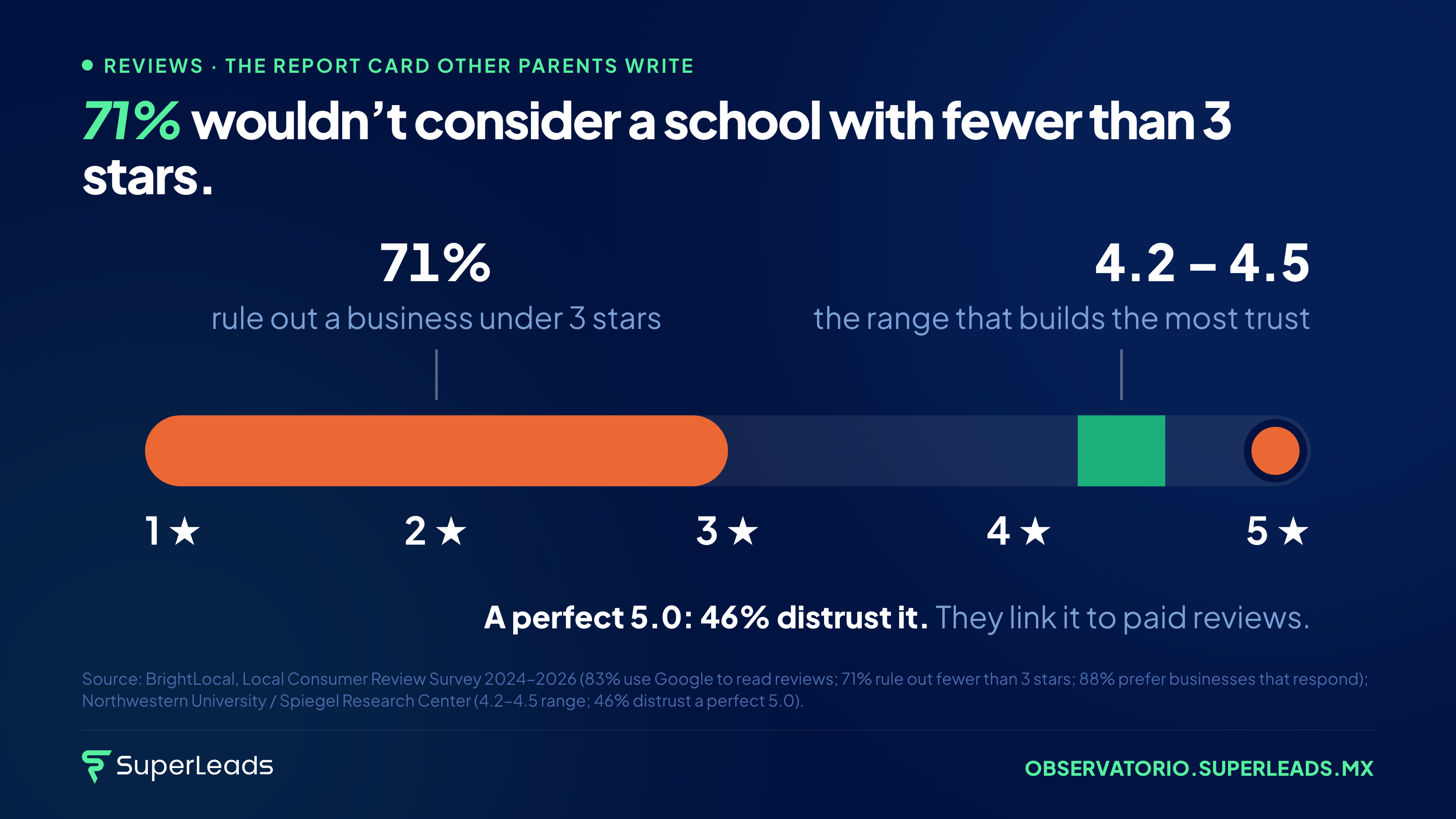
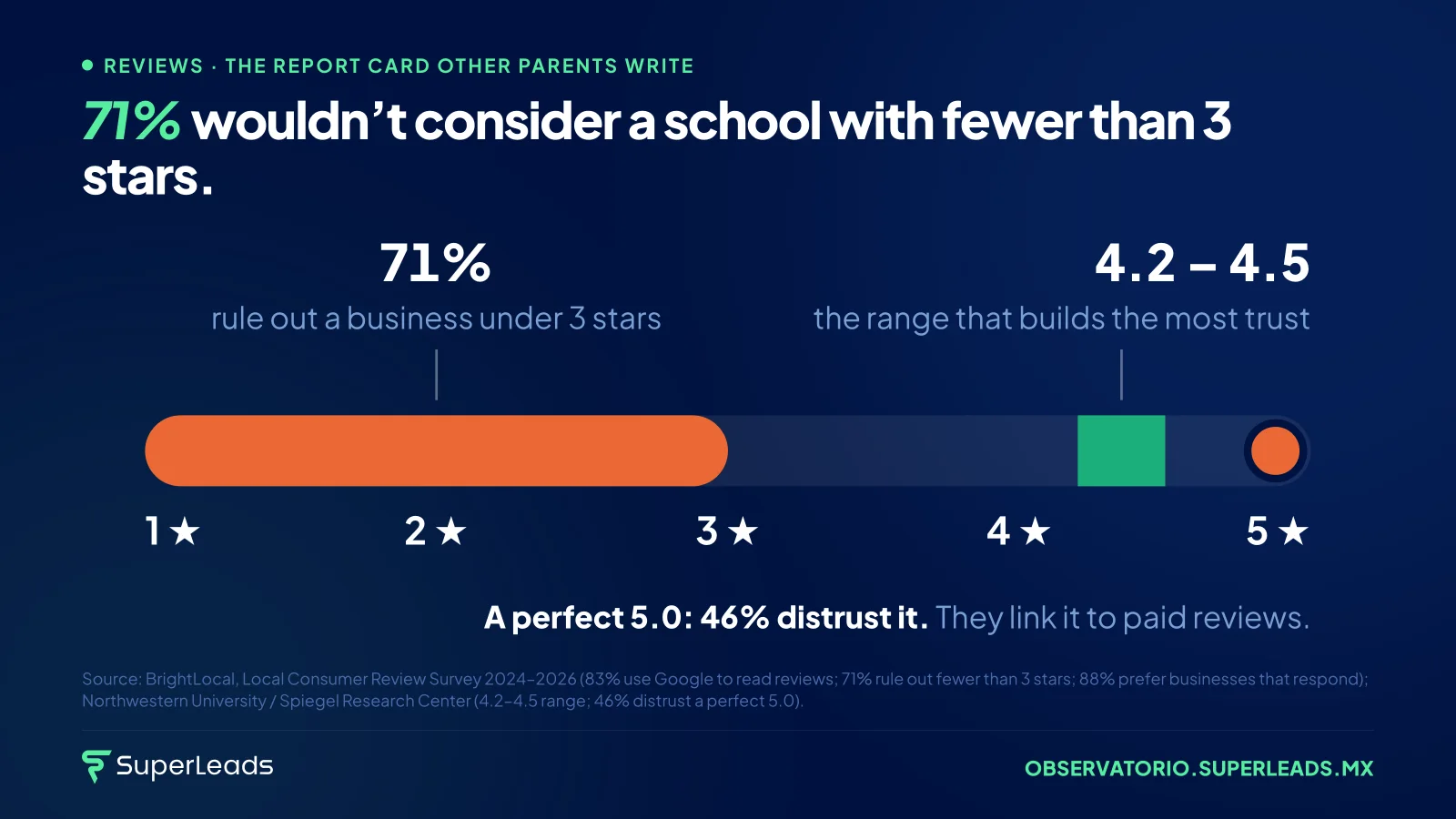
71% wouldn’t consider a school with fewer than 3 stars.

88% of consumers are more likely to choose a business that responds to all its reviews. A reply to a complaint isn’t for the parent who complained: it’s for the hundred families who will read it.

71% wouldn’t consider a school with fewer than 3 stars. 88% of consumers are more likely to choose a business that responds to all its reviews. A reply to a complaint isn’t for the parent who complained: it’s for the hundred families who will read it.
Source: BrightLocal, Local Consumer Review Survey 2024–2026 (83% use Google to read reviews; 71% rule out fewer than 3 stars; 88% prefer businesses that respond); Northwestern University / Spiegel Research Center (4.2–4.5 range; 46% distrust a perfect 5.0)

71% rule out a school with fewer than 3 stars; the most trusted range is 4.2 to 4.5

Google owns the conversation: 83% of consumers use it to read reviews. 71% wouldn’t consider a business with fewer than 3 stars. The range that builds the most trust is 4.2 to 4.5, and 46% distrust a perfect 5.0 because they associate it with bought reviews. 88% are more likely to choose a business that responds to all its reviews.

Word of mouth has always decided enrollments. What changed is its format: today it’s written, public, rated in stars, and read by every family weighing its options. The principal reviews students’ report cards every two months. Families review the school’s report card every day.

How often do you check your school’s report card? Does your latest negative review have a reply?

Source and method

Where it comes from

Source: BrightLocal, Local Consumer Review Survey 2024–2026 (83% use Google to read reviews; 71% rule out fewer than 3 stars; 88% prefer businesses that respond); Northwestern University / Spiegel Research Center (4.2–4.5 range; 46% distrust a perfect 5.0).

Document. P1-02 · The Invisible Report Card: How Families Decide (July 2026), by SuperLeads. Every figure keeps its official or international source; when the source gives a range, the range is shown here. Methodology.

On video

For your stories and status updates

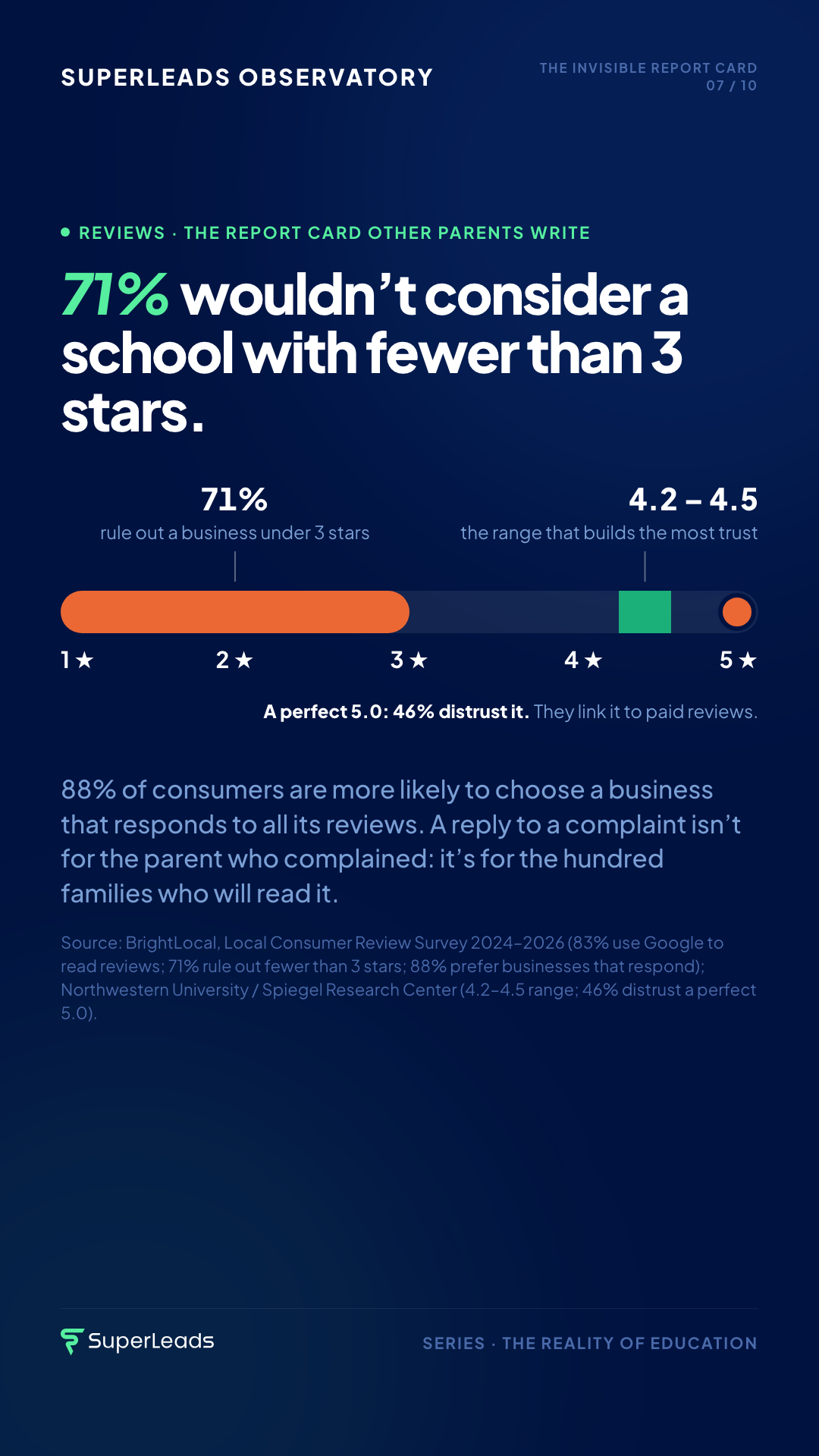
The same chart in vertical format, animated, 8 seconds long. Download it and post it as is to WhatsApp Status, Instagram Stories or TikTok — the source is already on it.

This data point airs as a YouTube Short (in Spanish) on December 8 at 7:30 p.m. Mexico City time. See the series playlist

Embed

Put it in your story or blog

Copy this code and paste it into your site: the chart shows in full and the source travels with it.

<iframe src="https://observatorio.superleads.mx/en/data/71-would-skip-a-school-under-3-stars/embed/" width="100%" style="aspect-ratio:16/10.4;border:0;max-width:960px" loading="lazy" title="71% wouldn’t consider a school with fewer than 3 stars. · SuperLeads Observatory"></iframe>
Enrollment X-Ray

And your school — where does it stand?

These figures come from 102 sessions like the one you can have. In an Enrollment X-Ray we put your institution’s admissions numbers in order, and you walk away with a PDF of the ones that matter most.

  • Your occupancy, conversion and cost per student, against your peers
  • How much money you leave on the table every cycle, in numbers
  • What to change first, in order

No commitment. We work with owners and directors of private schools and universities. Sessions are held in Spanish.

Book your Enrollment X-Ray First, benchmark your school here

Or message us directly on WhatsApp:

The SuperLeads system

Four pieces, always together.

Technology

Admissions CRM, WhatsApp, AI agent and dashboard in one place. Built to enroll, not to grade or collect payments.

Methodology

What to say, when and why at every stage of the funnel. Proven in more than 70 institutions.

Execution

Our team makes the changes for you every month, measured in credits and quoted before work begins.

Support

Always included: questions and issues handled around the clock by Alex and the human team, without using credits.

Software gets delivered. A system gets installed, operated and audited. See the system →