
Nine in ten Mexican children attend a public school. I work with private schools every day, and even so, or precisely because of it, I have spent years reading everything published about public schools. The reason is simple: almost no family walks into a private school asking about the private school. They walk in asking, “What happens if we don’t?” What happens if my child stays at the school they’ve been assigned.
This article answers that question with data. Not with impressions or anecdotes, but with figures from the OECD, Coneval, Mexico’s Federal Audit Office (Auditoría Superior de la Federación), UNESCO, INEGI and SEP itself. It is not an attack on teachers, who, as you will see, are as much victims of the system as their students. It is a reading of the reality worth working from, whichever side of the counter you stand on.
It is also a document that is getting harder to put together. Much of this information is no longer produced: the country dismantled its tools for measuring education, and what goes unmeasured tends to vanish from the debate. That is why I am writing it now, with the latest figures that exist.
1. What they learn, and what they don’t
The most recent international snapshot of learning in Mexico is the OECD’s PISA 2022. The most recent, because after that the country stopped measuring itself. The picture is this: Mexico ranked 35th of 37 OECD countries. Third-worst in Mathematics and Reading; the worst in the entire OECD in Science.
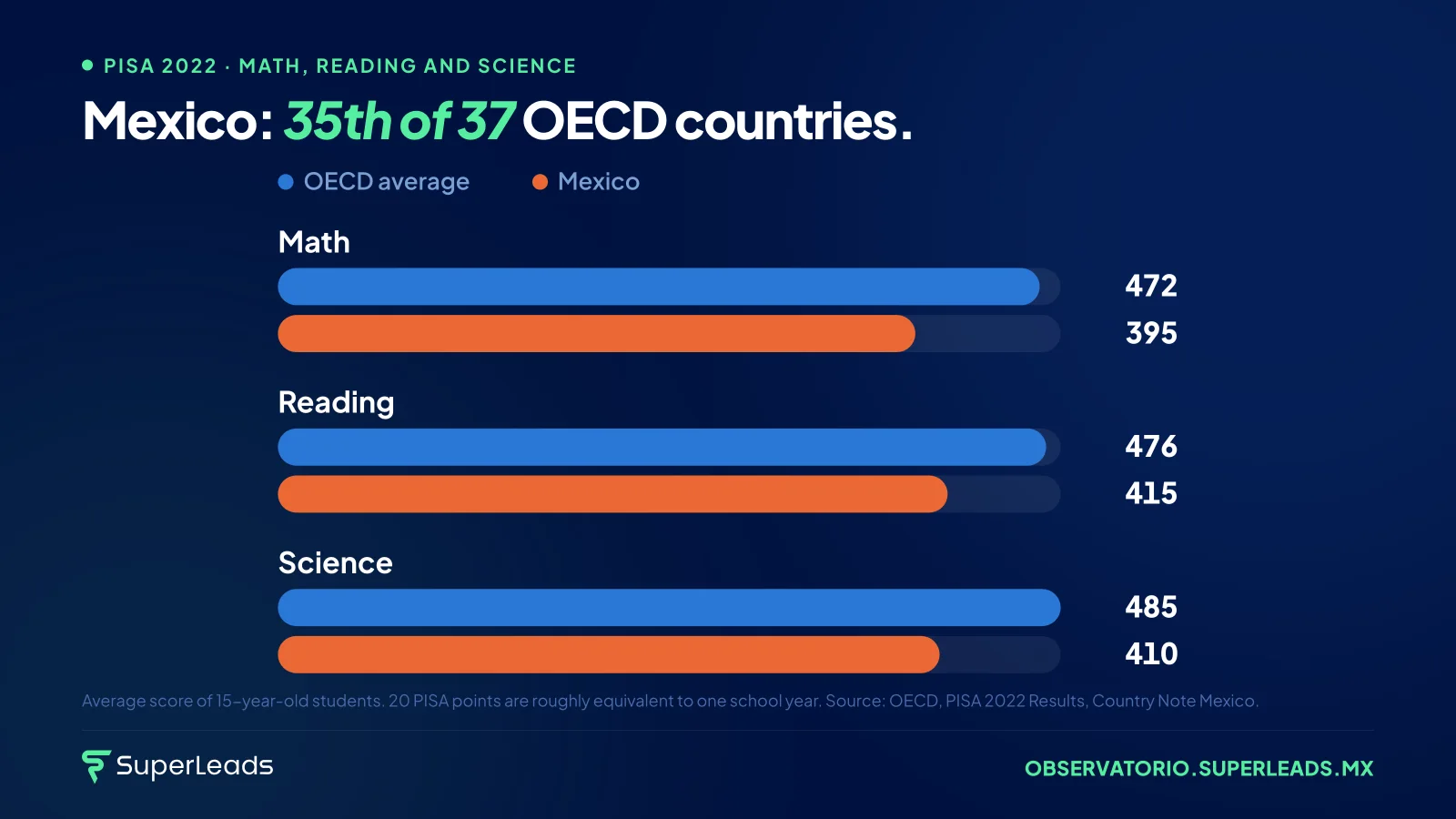
In Mathematics, Mexican 15-year-olds scored 395 points against an OECD average of 472: 77 points behind. Twenty PISA points are roughly equivalent to one school year. In Reading, 415 versus 476. In Science, 410 versus 485.
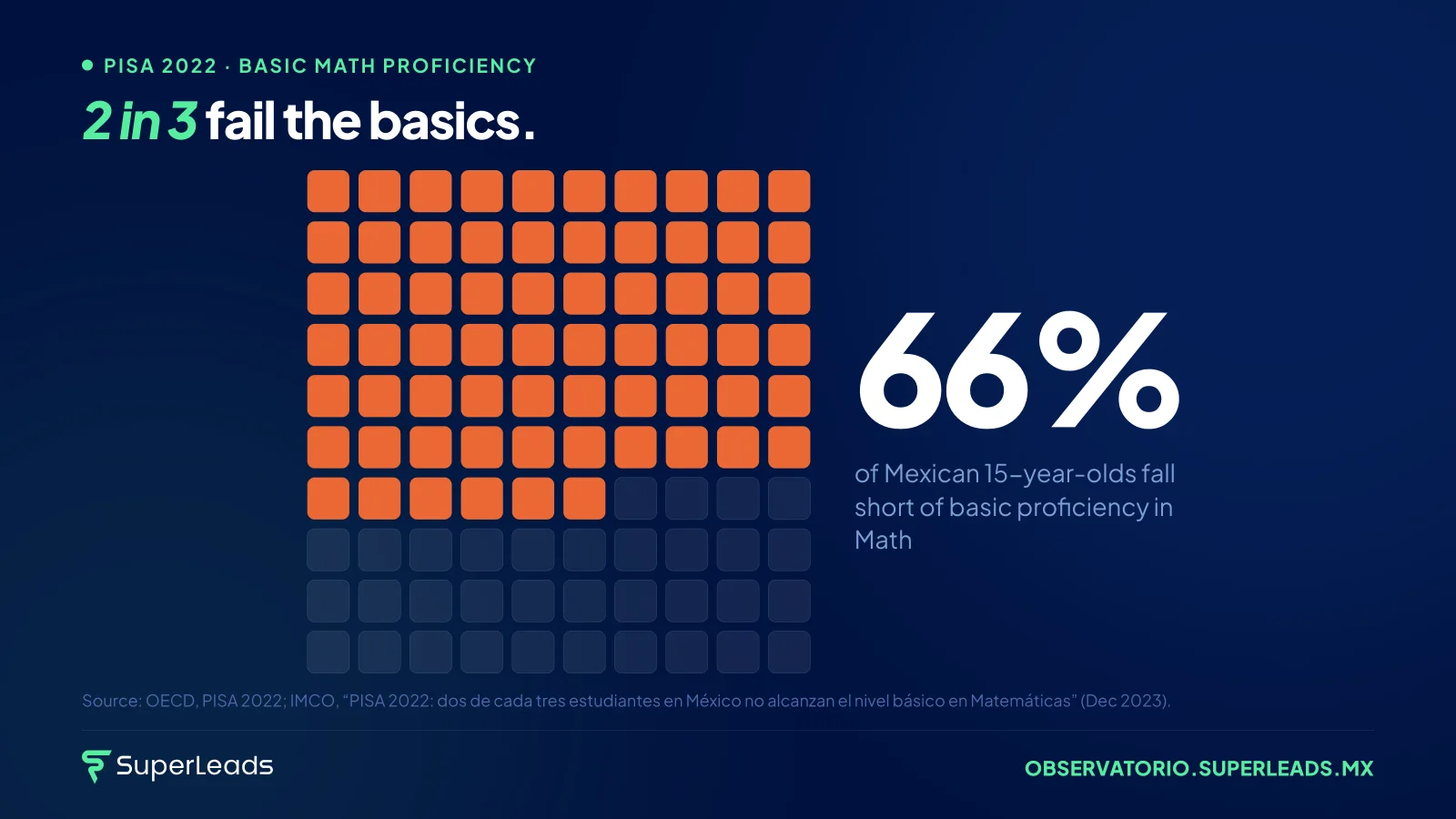
Among Mexican 15-year-olds, 66% fall short of basic proficiency in Mathematics. 47% cannot read with even minimal comprehension. Just 1% reach top performance levels in Reading; in Mathematics, practically 0%.
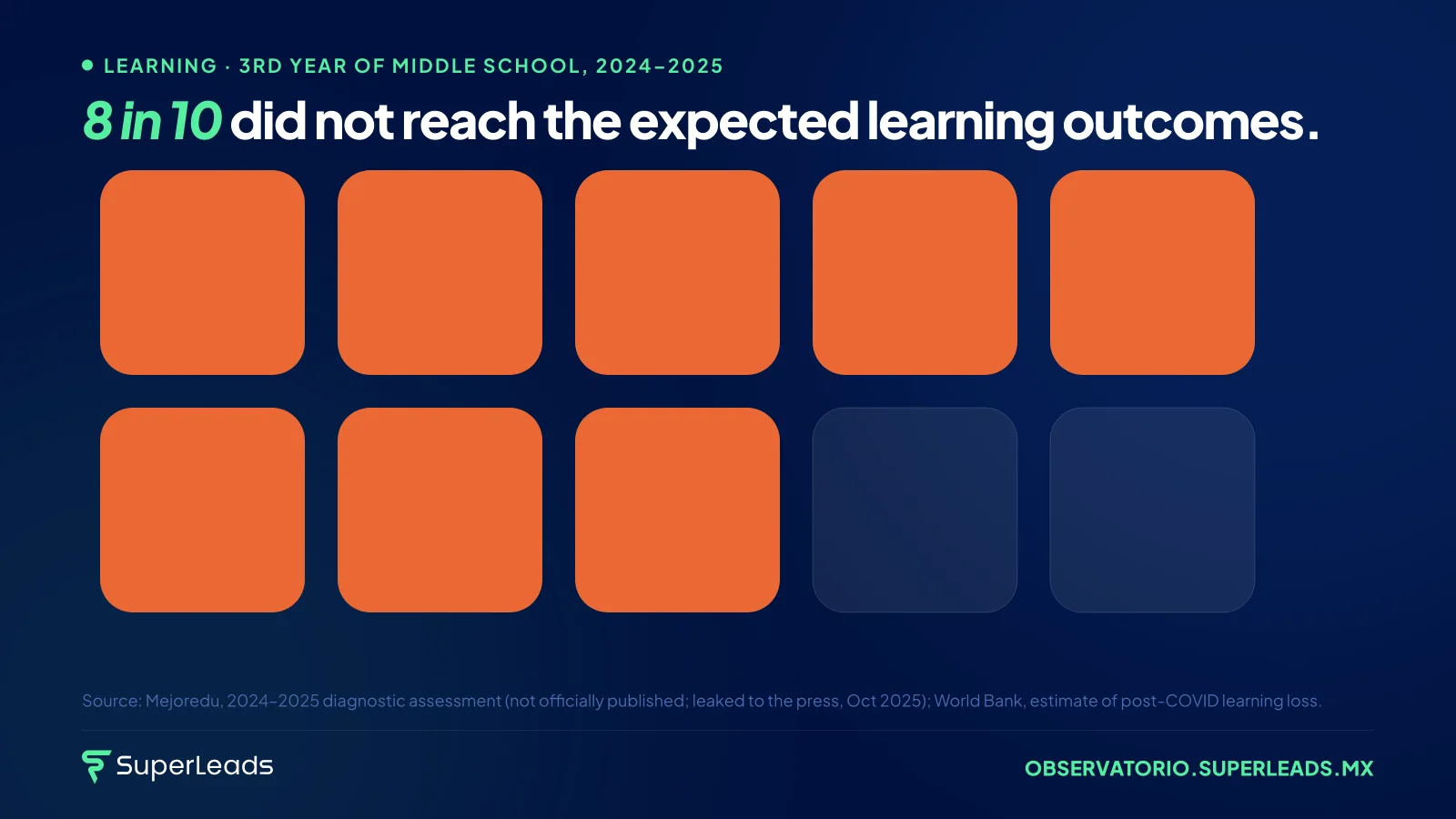
The World Bank estimates that the pandemic added a learning gap equivalent to two years of schooling: today’s average middle school graduate knows what a student just starting middle school used to know. And the most recent national assessment on record, Mejoredu’s for the 2024–2025 school year, which was leaked to the press, found that 8 in 10 students in their final year of middle school had not reached the expected learning outcomes.
2. The school building: learning without water, power or internet
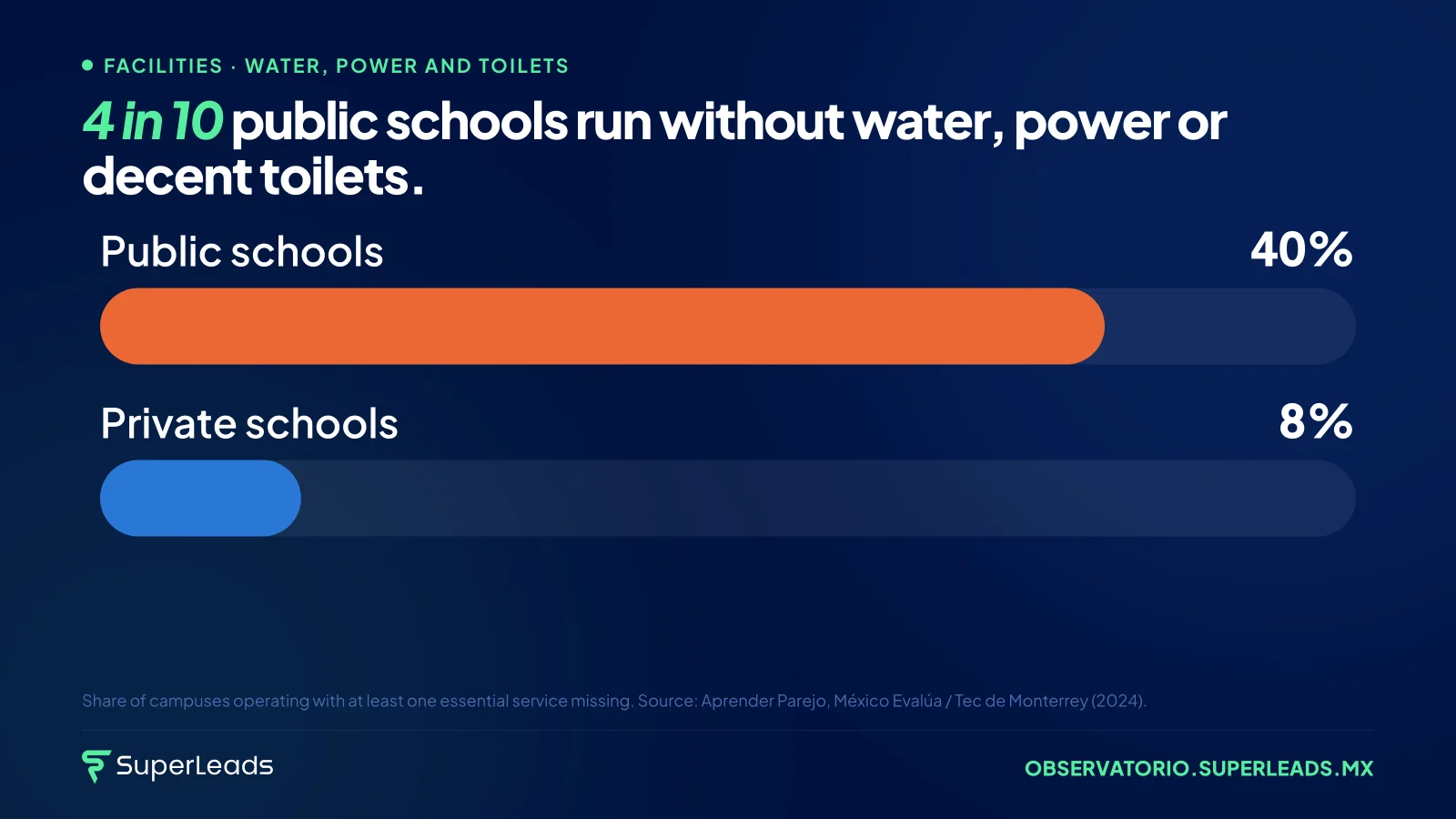
Educational inequality in Mexico does not start in the classroom. It starts with the building. According to Aprender Parejo, a study by México Evalúa and Tec de Monterrey, 40% of public schools lack at least one basic service: water, electricity or decent toilets. Among private schools, the figure is 8%.
Official figures confirm it piece by piece. According to SEP, in the 2023–2024 school year 9,034 public schools in basic education (preschool through middle school) had no access to drinking water and 5,112 had no electricity. According to Coneval, 89,000 basic-education schools have no sewage connection. According to the Federal Audit Office, 61% of primary schools have exceeded their 25-year structural service life. And 31% of the schools assessed by INIFED showed structural damage.
Meanwhile, 65 out of every 100 public schools operate without computers or internet. In a country whose economy runs on the USMCA, nearshoring and tourism, two in three public schools do not have a single connected computer.
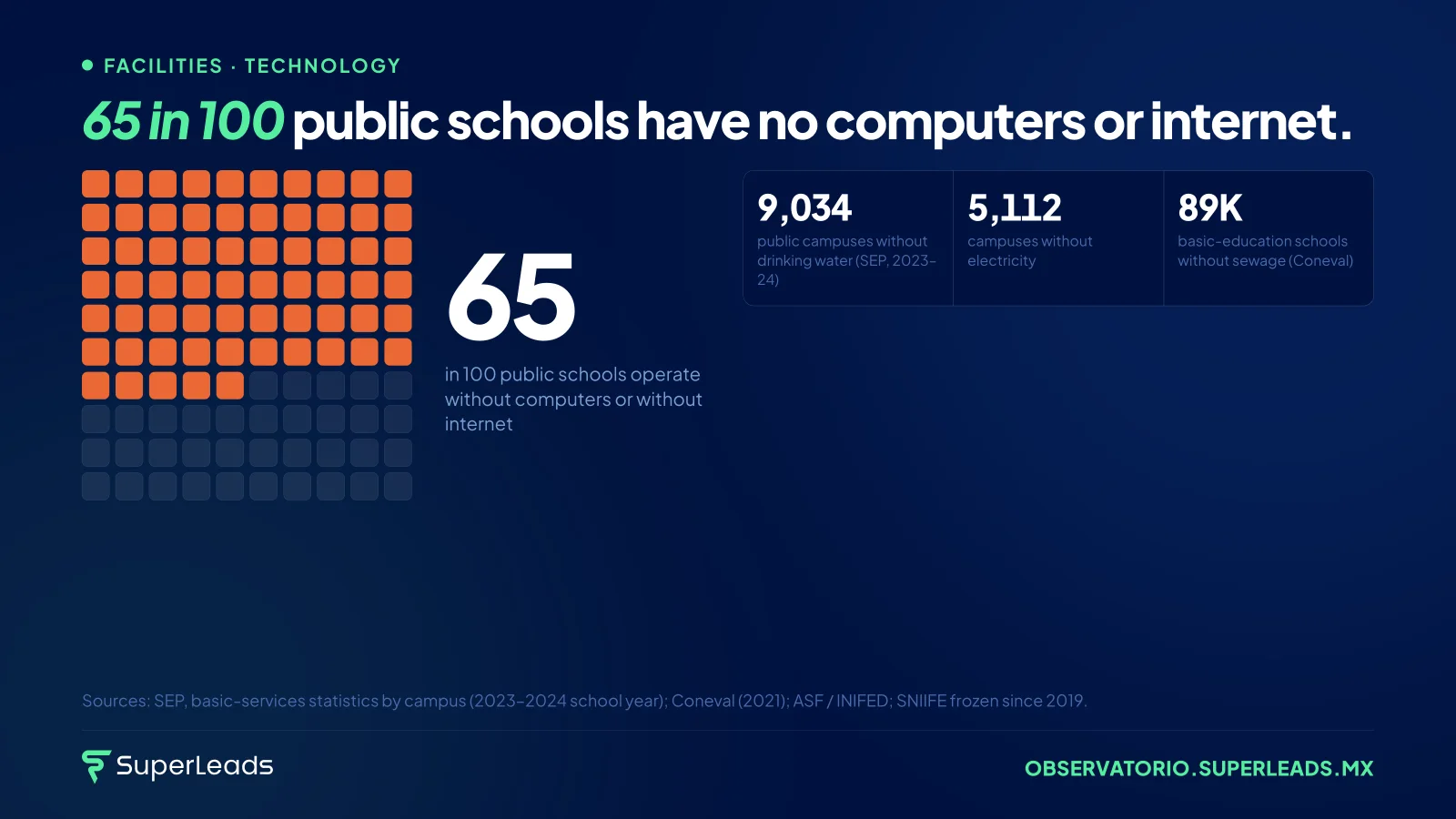
What stands out is not a lack of money. Between 2013 and 2024, $451,230 millionMXN was spent on school infrastructure. But the national school infrastructure census has not been updated since 2019, so no one can say, officially, what that money became. The budget was spent and the meter was switched off.
3. Who is in front of the class
This needs to be said plainly: the Mexican teacher is not the villain of this story. Teachers are its second victim. INEGI data from its ENOE labor survey for the first quarter of 2025, covering the country’s roughly two million teachers, put a teacher’s average monthly income at $7,890MXN. The 2025 minimum wage is $8,400MXN. A preschool teacher averages $6,430MXN; a high school teacher, $6,260MXN.
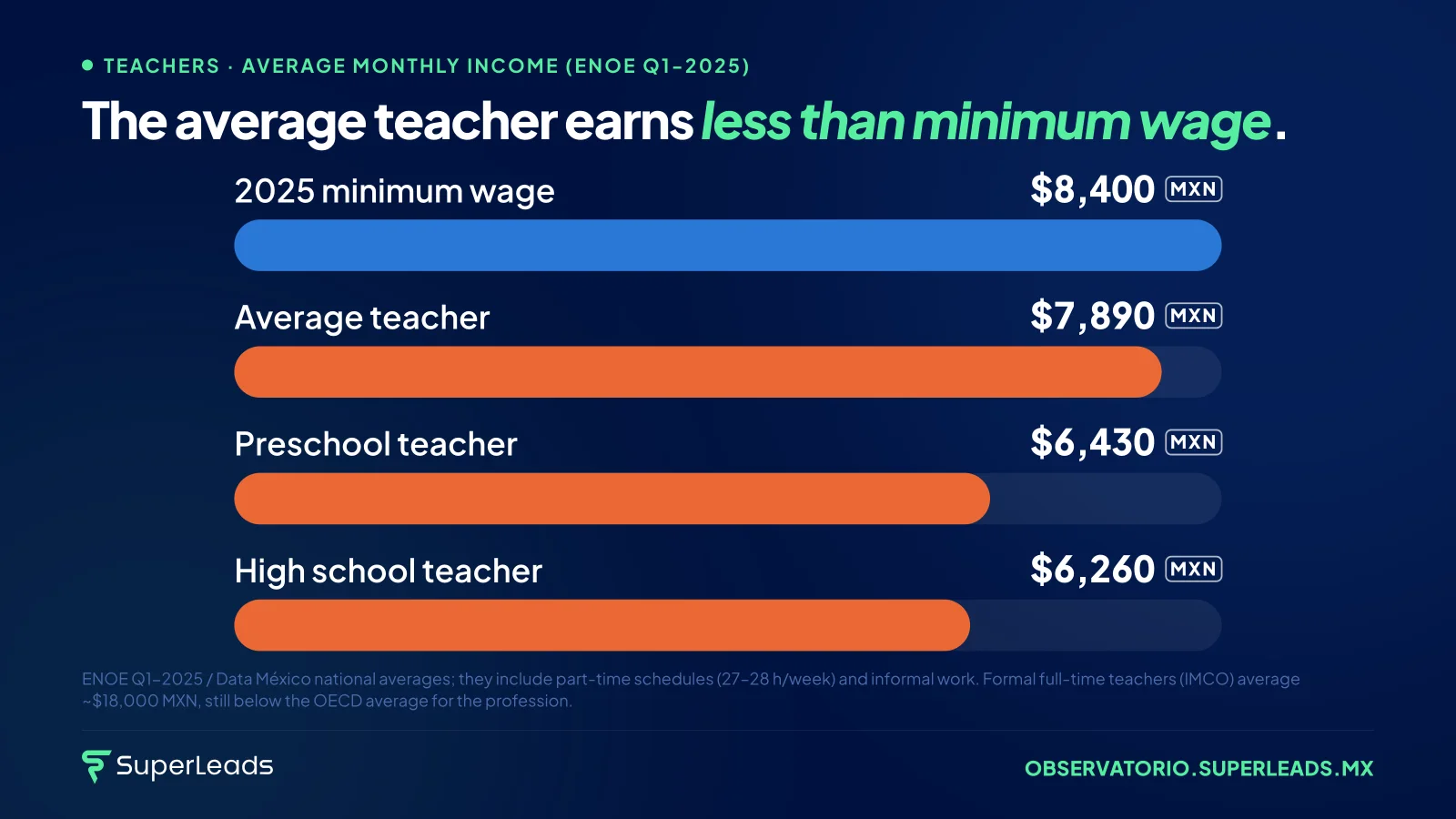
These are national averages that include part-time and informal work. Measurements of formal, full-time teachers, such as IMCO’s, raise the average to about $18,000MXN, still below the OECD average for the profession. The OECD fills in the structural picture: Mexico combines one of the heaviest teaching loads in the organization with one of the lowest base salaries.
Two policy decisions make it worse. Teacher training is sporadic and has no follow-up. And since 2019, when mandatory teacher evaluation was scrapped, there has been no national mechanism to verify the skills of whoever is standing in front of a class. The system’s message to its teachers is consistent and devastating: I pay you little, I don’t train you, I don’t evaluate you. Low morale is not a flaw of the teaching profession. It is the rational response to those incentives.
4. The calendar that isn’t kept
June 2026 brought the most geographically widespread disruption to schooling in decades. According to SEP’s own figures as of June 5, the national strike by the CNTE teachers’ union, which began on June 1, shut 17,471 schools in the home stretch of the school year, leaving 1,410,459 students without classes and 88,546 teachers on strike across ten states. In Oaxaca, 92.13% of the state’s students did not get a single day of class.
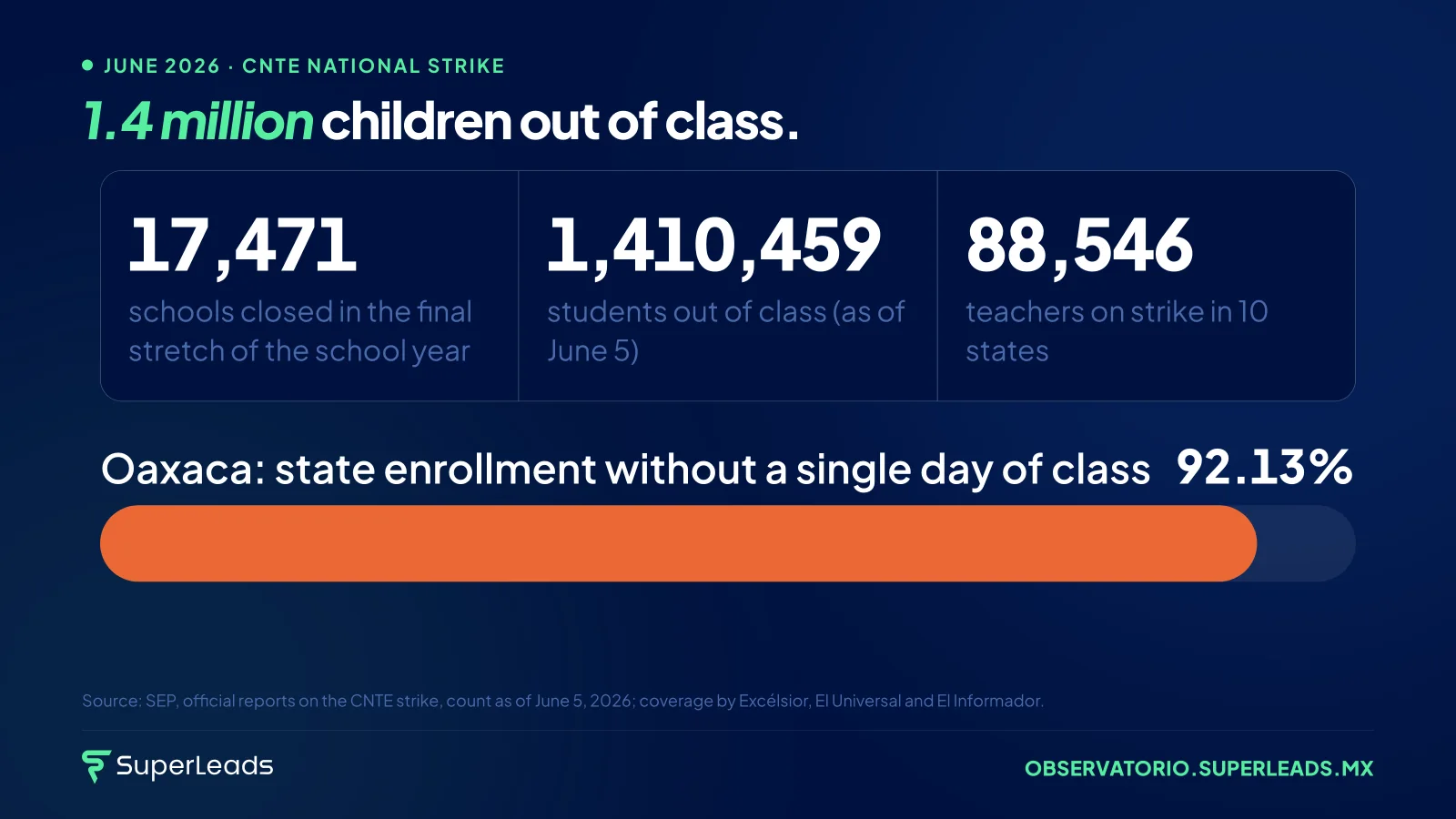
This is not an extraordinary event. It is a pattern that has repeated every school year for decades, with varying intensity from state to state, and its effects are cumulative: every week lost in the early years of schooling is a hole that is rarely filled, and it hits hardest the families without access to private tutoring, a computer or the internet.
For families, the practical consequence is uncertainty: when they enroll for the year, they don’t know how many days of class their child will actually get. A reliable calendar, something so basic that no private school bothers to advertise it, is one of the advantages most valued by families who move from public to private school.
5. English: a subject students pass without learning it
The most thorough diagnosis of English in public schools, Mexicanos Primero’s study Sorry, has yet to be refuted, and later evidence points to further decline. Among public middle school graduates, 97% do not reach the English level set by SEP’s own curriculum. 86% of public basic-education schools do not even have an English teacher. And 52% of the teachers who do teach it fall short of the B1 level expected of their students.
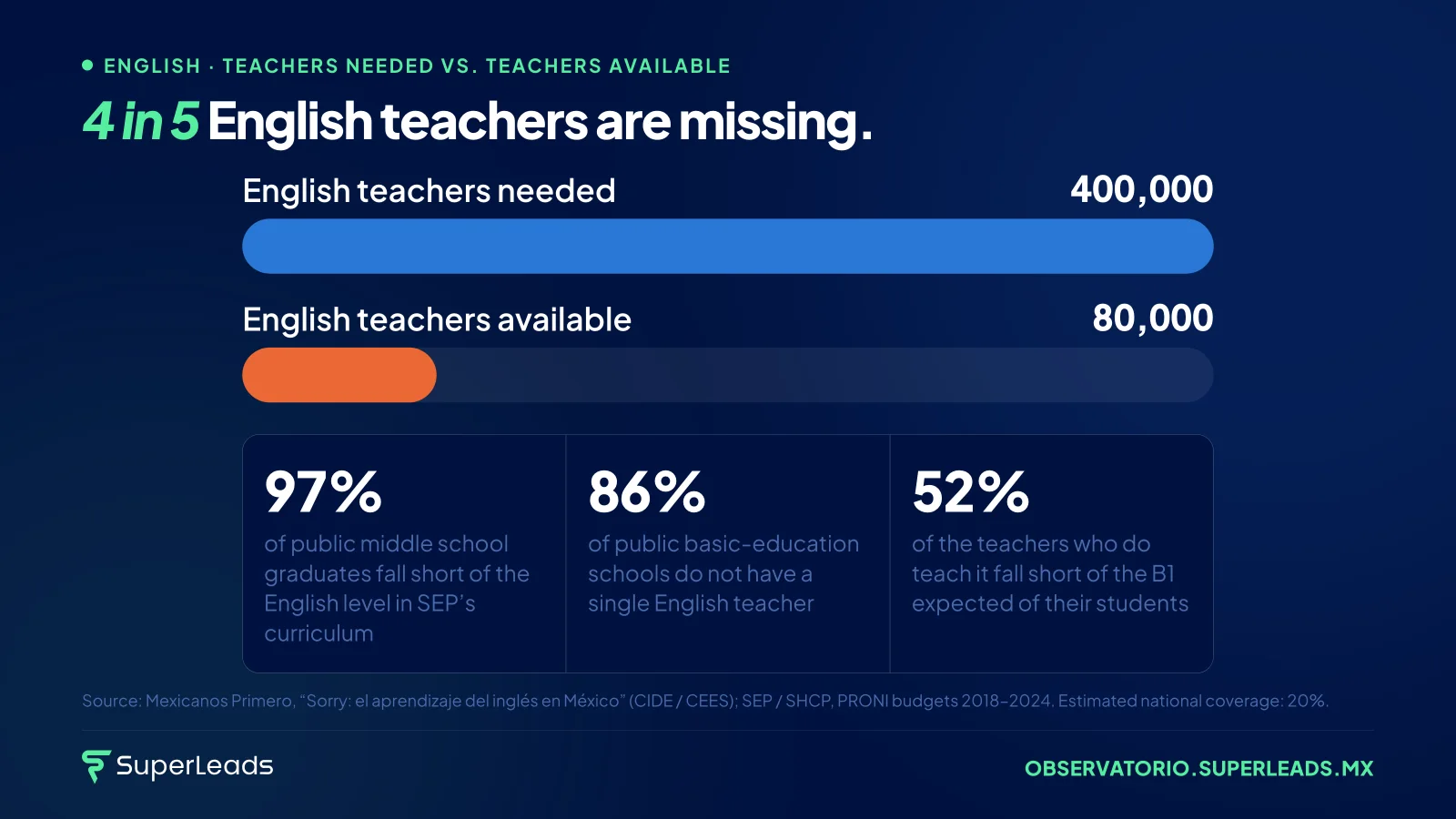
Mexico needs 400,000 English teachers and has 80,000. Public enrollment receiving English instruction fell 43%, from 9.2 million to 5.2 million students, and the budget for the National English Program shrank 27% in real terms between 2018 and 2024. In public primary schools, English is not even mandatory. A private school child takes English from preschool on. A public school child has an 86% chance of never having an English teacher at all.
6. How much the state invests in each child
Behind every section so far lies a common cause, and the OECD measures it every year in Education at a Glance. Mexico ranks last in the OECD in spending per primary school student: $2,933USD a year. Luxembourg invests $25,584USD; the United States, $15,270USD; the OECD average is $11,902USD. Countries with a lower GDP per capita than Mexico, such as Colombia, Bulgaria, Turkey, Hungary and Romania, invest more per child.
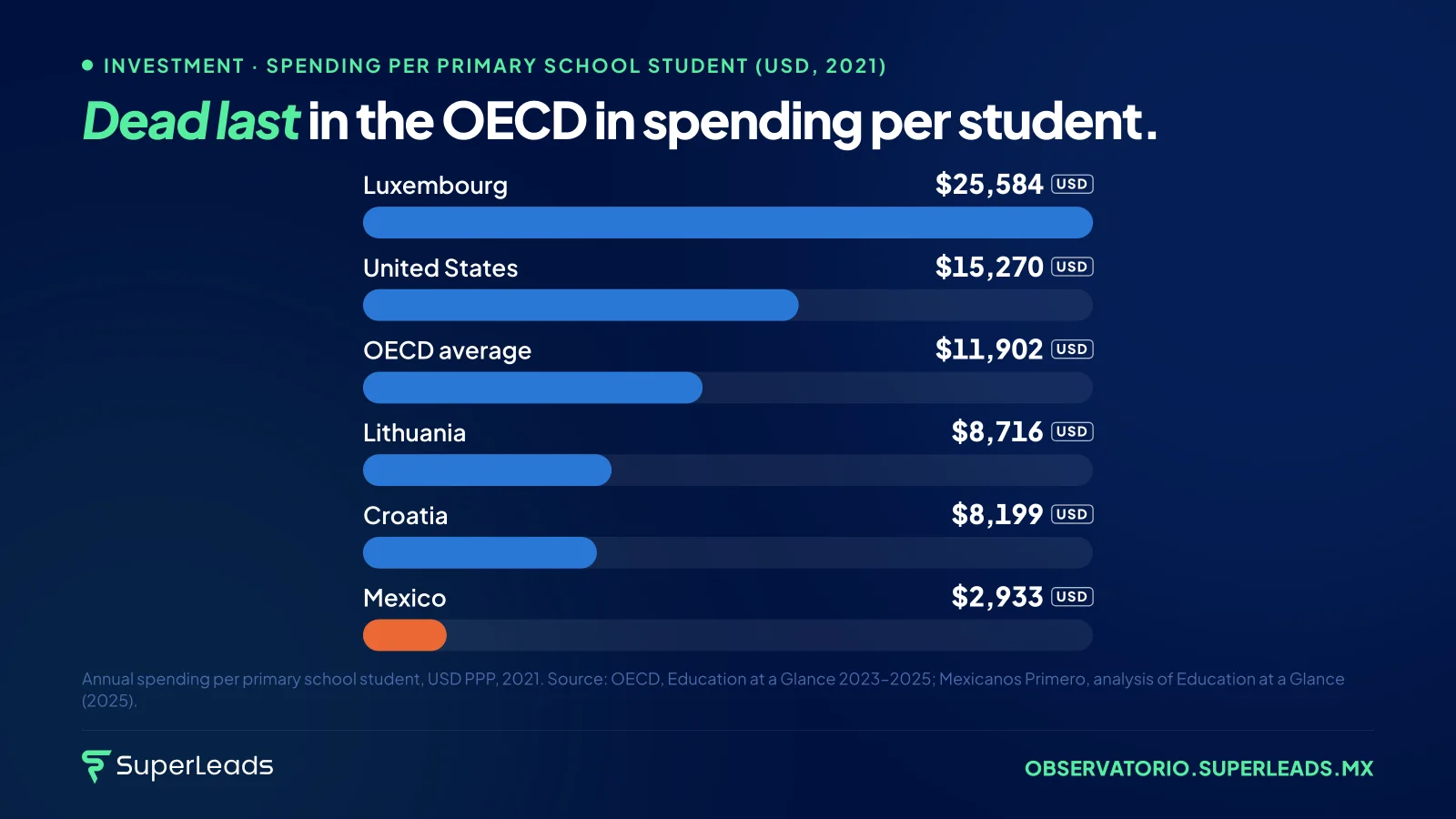
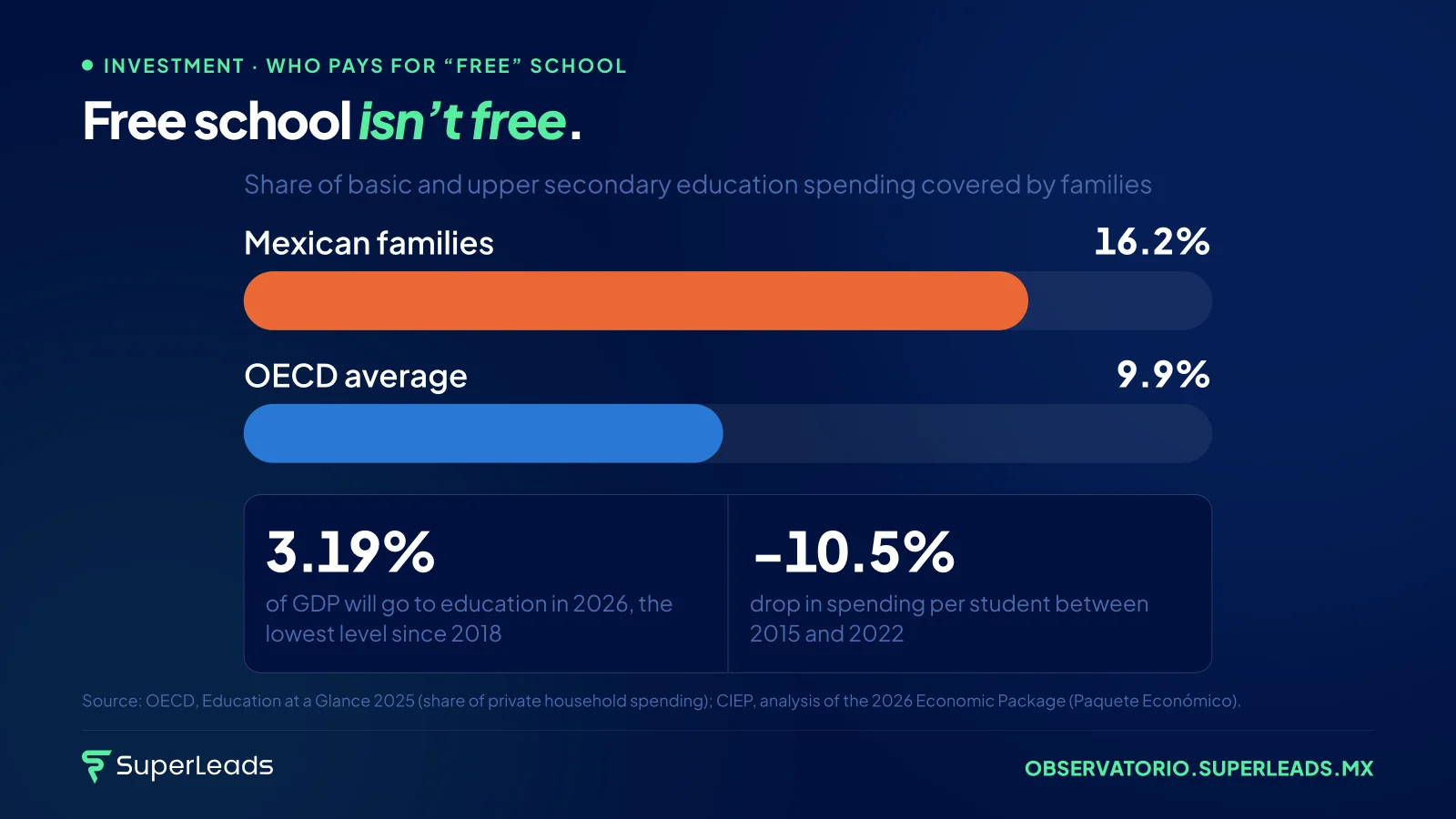
And the trend is downward. Spending per student fell 10.5% between 2015 and 2022 while the OECD average rose. Education spending in 2026 amounts to 3.19% of GDP, the lowest level since 2018. The mix has shifted too: about $180 billionMXN a year goes to universal scholarships that, according to specialists, have not improved coverage, retention or learning, while the cuts fall on what builds capacity: schools, teachers, materials, assessment.
One more fact closes the loop: “free” public school isn’t free. Mexican families cover 16.2% of education spending in basic and upper secondary education, through parent contributions, school supplies and building maintenance. The OECD average is 9.9%. Mexican families already pay for public education. What they don’t get in return is the service.
7. The country that broke its thermometers
If some of the figures in this article struck you as dated, that is not carelessness on my part. It is the central finding: Mexico systematically dismantled its tools for measuring education. The timeline, verified by UNESCO in its Mexico Country Strategy 2026–2031, runs as follows.
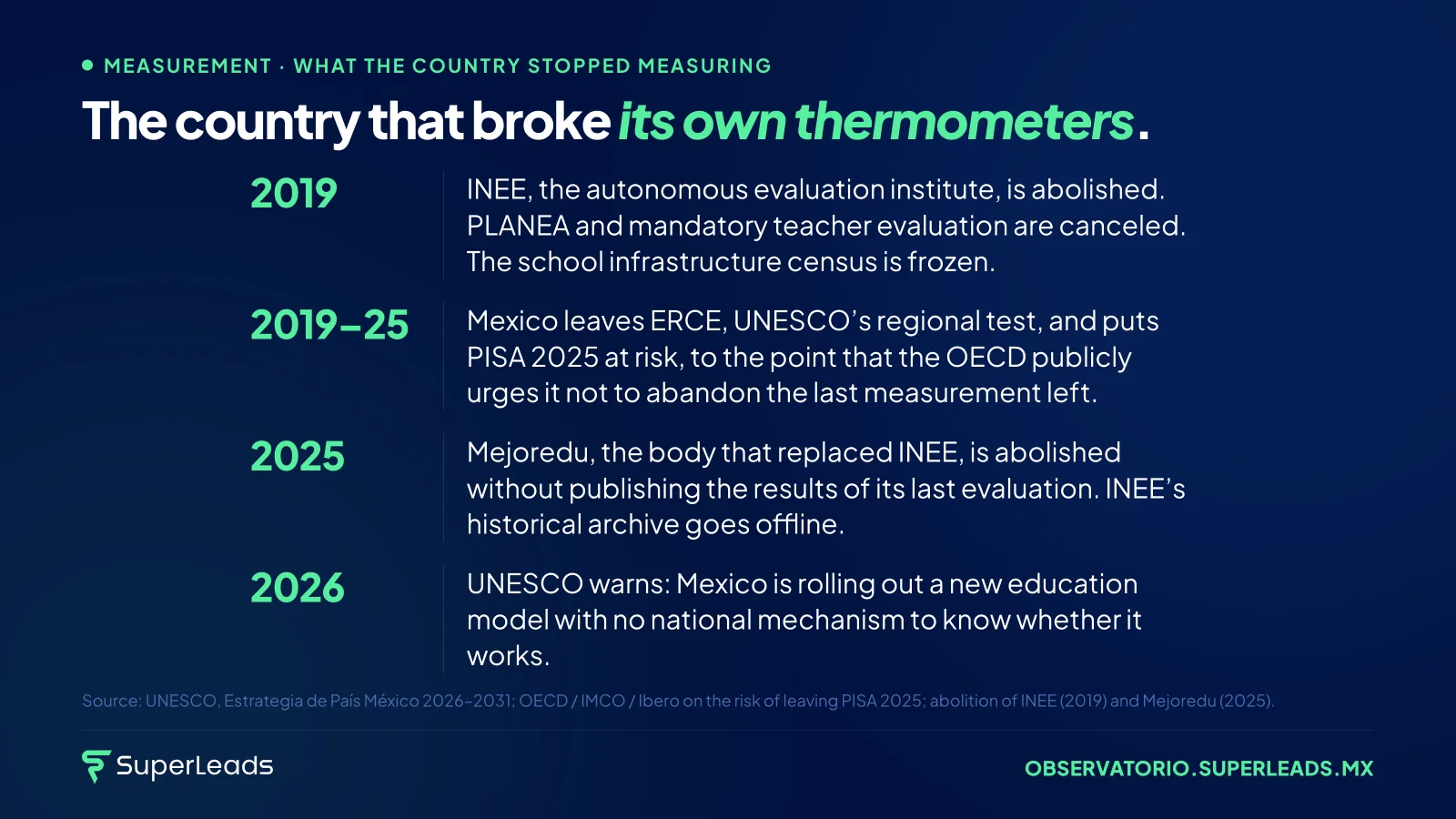
In 2019, the INEE, the autonomous institute for educational evaluation, is abolished. The nationwide census-based tests (PLANEA) and mandatory teacher evaluation are canceled. The school infrastructure census is frozen. Between 2019 and 2025, Mexico pulls out of ERCE, UNESCO’s regional assessment, and puts its participation in PISA 2025 at risk, to the point that the OECD publicly urges it not to abandon the last measurement it has left. In 2025, Mejoredu, the agency that replaced the INEE, is abolished without publishing the results of its last diagnostic assessment. In 2026, UNESCO warns that Mexico is rolling out a new education model, the Nueva Escuela Mexicana (New Mexican School), with no national mechanism to tell whether it works.
No serious system destroys its measuring instruments when results are good. They get destroyed when results are indefensible. The opacity is not an administrative oversight. It is a policy. And the consequence for everyone is that the public debate on education runs on data from 2022 and earlier.
What this means
Add it all up and you get the path of the average child in public school: a building that, in 4 out of 10 cases, lacks basic services; a teacher who earns less than the minimum wage, with no training and no evaluation; weeks of class lost every school year; an 86% chance of never having an English teacher; and, by age 15, a 66% chance of not mastering basic math.
I want to be clear about one thing. I would like public schools to work. They are the only real way forward for a country of 130 million people, and I hope that someday they will. But today, realistically, they are not working, and the family deciding where to enroll their child knows it before any report does. That is why, while public schools get fixed, private education is neither a luxury nor unfair competition: it is essential to this country. Every family that finds a good private school is one more child taken out of these statistics.
If you run a private school, this article is your case, sourced and free of adjectives. The most powerful admissions conversation is not “we’re better than School X.” It is “this is what your child gets here, and this is what the system guarantees them otherwise.” The family moving from public to private school is not comparing schools. It is buying certainty. And the first proof of certainty you give them is not your facilities or your educational model: it is how you respond in the first 24 hours after they show interest. At SuperLeads, that stretch is exactly what we work on, and it is what I will write about in the next article. If you want the data in this piece for your own case, write to me: ricardo@superleads.mx.
Sources
OECD, PISA 2022 Results and Country Note Mexico; IMCO, “PISA 2022: dos de cada tres estudiantes en México no alcanzan el nivel básico en Matemáticas” (2023) and Compara Carreras (2025); World Bank, post-COVID learning loss estimates; Mejoredu / El Universal, 2024–2025 diagnostic assessment; México Evalúa / Tec de Monterrey, Aprender Parejo (2024); Coneval, Información Estratégica para el Regreso a Clases (2021); SEP, statistics on basic services by school, 2023–2024 school year, and official reports on the CNTE strike as of June 5, 2026; ASF and INIFED, age and structural damage of school buildings; INEGI, ENOE Q1-2025; Data México, wages by education level; Mexicanos Primero, Sorry: el aprendizaje del inglés en México and analysis of Education at a Glance (2025); SEP / SHCP, National English Program budgets 2018–2024; OECD, Education at a Glance 2023–2025; CIEP, Paquete Económico 2026; UNESCO, Estrategia de País México 2026–2031. Full methodology and sources available on request: ricardo@superleads.mx.
SuperLeads Observatory · October 30, 2026