
I wrote two articles before this one. In the first, I laid out the state of Mexico’s private education market using the numbers from 102 Enrollment X-Rays: the median institution operates at 46% of capacity. In the second, I described the state of public education using the official and international figures that still exist: 66% of 15-year-olds fall short of basic proficiency in math. This third article brings the two together, and it reaches what I consider the most important conclusion of the three.
School owners and principals in Mexico are looking at one of the biggest opportunities I have seen in any industry. At the same time, they carry an enormous responsibility: they need to be more ambitious. They should want their schools to grow far more, because every student they enroll is a genuine good for the country. What they lack isn’t a market or a calling. It’s knowing how to sell themselves. Let me explain with data.
1. The real size of the market
There is one question almost no school leader has asked with the data in hand, and it is the first one worth answering. It isn’t “How much competition do I have?” It’s “How far has private education penetrated my country?”
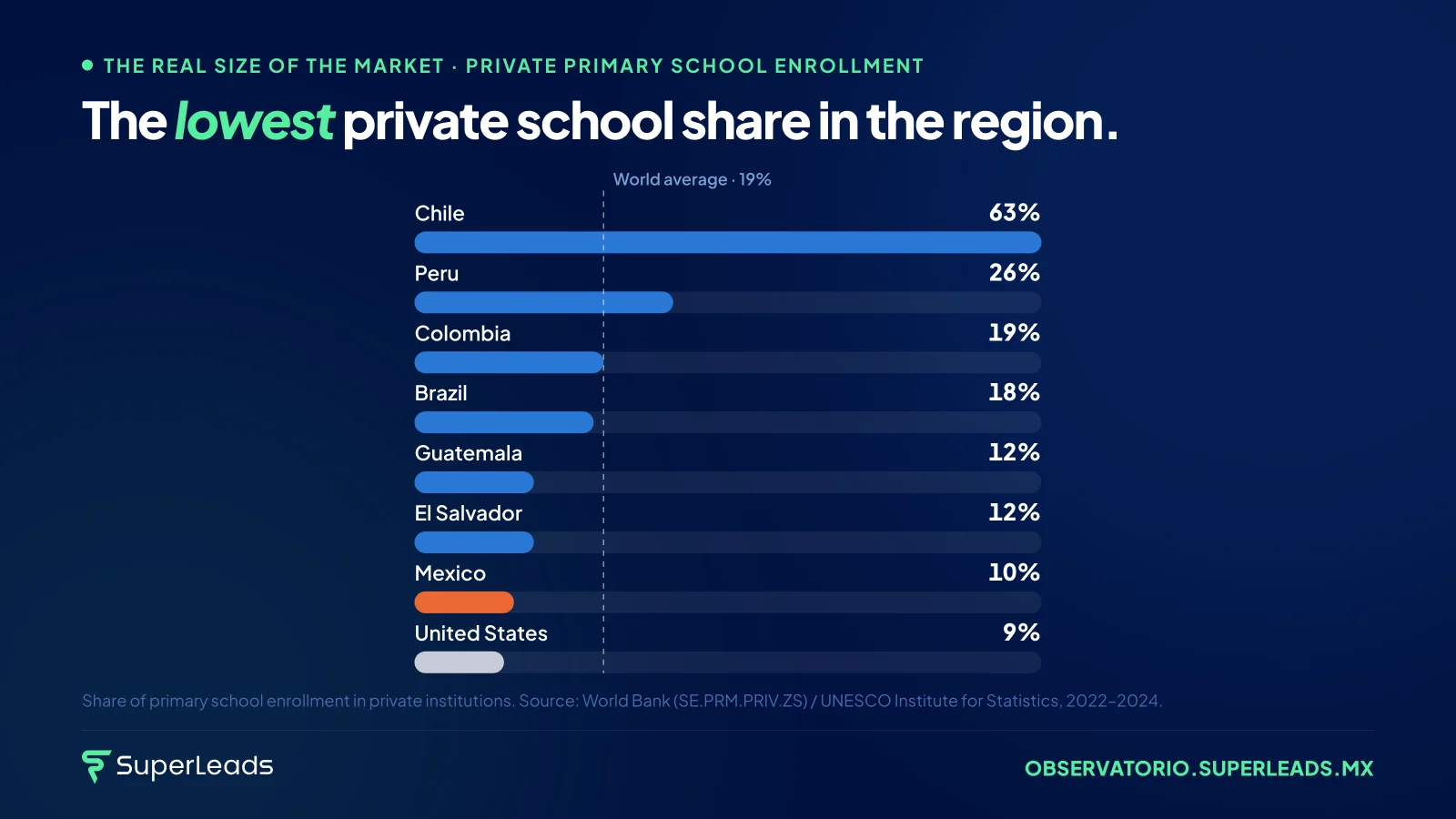
Only 10% of Mexico’s students attend a private school. That is the lowest penetration in Latin America, according to the World Bank and the UNESCO Institute for Statistics. Chile is at 63%. Peru, 26%. Colombia, 19%. Brazil, 18%. Guatemala and El Salvador, 12%. The global average is 19%. Mexico, the region’s second-largest economy, with 38 million households and one of the largest urban middle classes on the continent, sits at the level of the United States, where public schools compete with budgets from another planet.
When a Mexican school leader says “there are too many schools,” the data says otherwise: Mexico has far too few families in private school for the size of its economy. Private education in Mexico is not a saturated market. It is an underdeveloped one. And an underdeveloped market is, by definition, a market waiting to be captured.
2. “People just can’t afford it”
That first conclusion is always met with the same objection. It’s a comfortable explanation, because it lets everyone off the hook. It is also false, and the socioeconomic pyramid proves it.
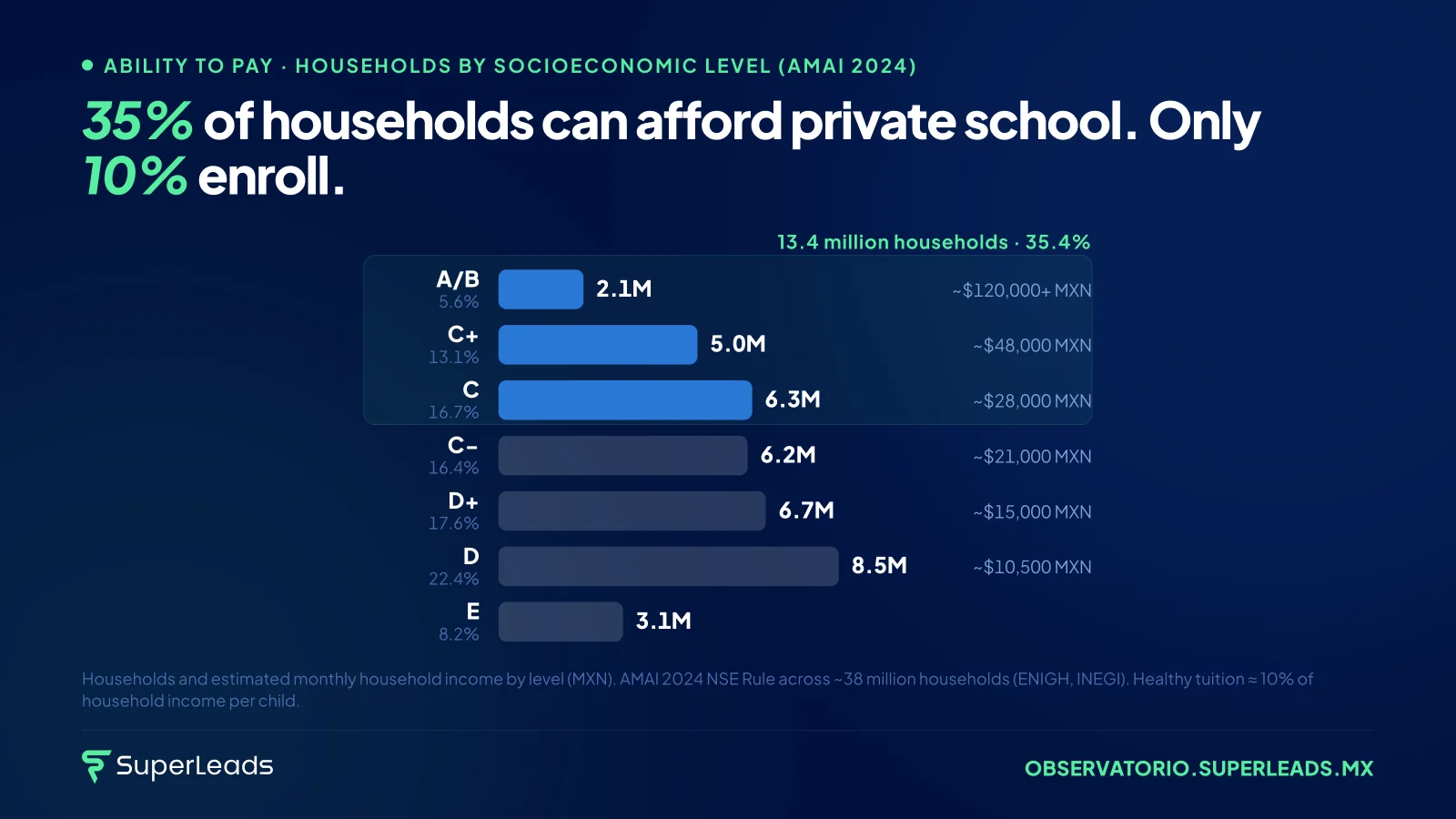
AMAI’s NSE Rule, the socioeconomic standard Mexico’s entire consumer industry uses to segment its customers, sorts the country’s roughly 38 million households into seven levels. The top three are the private school’s natural territory: A/B, 5.6% of households, some 2.1 million families with incomes above $120,000MXN a month; C+, 13.1%, some 5 million with around $48,000MXN; and C, 16.7%, some 6.3 million with close to $28,000MXN.
Add them up: 13.4 million households, 35% of the country. Apply the sector’s most widely accepted rule of thumb, that healthy tuition runs about 10% of family income per child, and those households can sustain monthly tuition from $2,800MXN to more than $12,000MXN. That is exactly the range in which the vast majority of the country’s private schools operate. And yet only 10% of enrollment is private.
Read that again: Mexico has more families who can afford private school than families who are paying for it. That gap is the growth ceiling for the entire sector, and it is a very long way off.
3. Proof from Peru
Peru dismantles the money objection with elegance. There, levels A and B add up to just 10.4% of households, with incomes far below their Mexican equivalents. Even so, 26% of Peruvian students attend private school, because level C families, and even level D families, pay monthly tuition of 300 to 600 soles for a reason that shows up in no income survey: they decided public education was not an option for their children, and adjusted everything else around it.
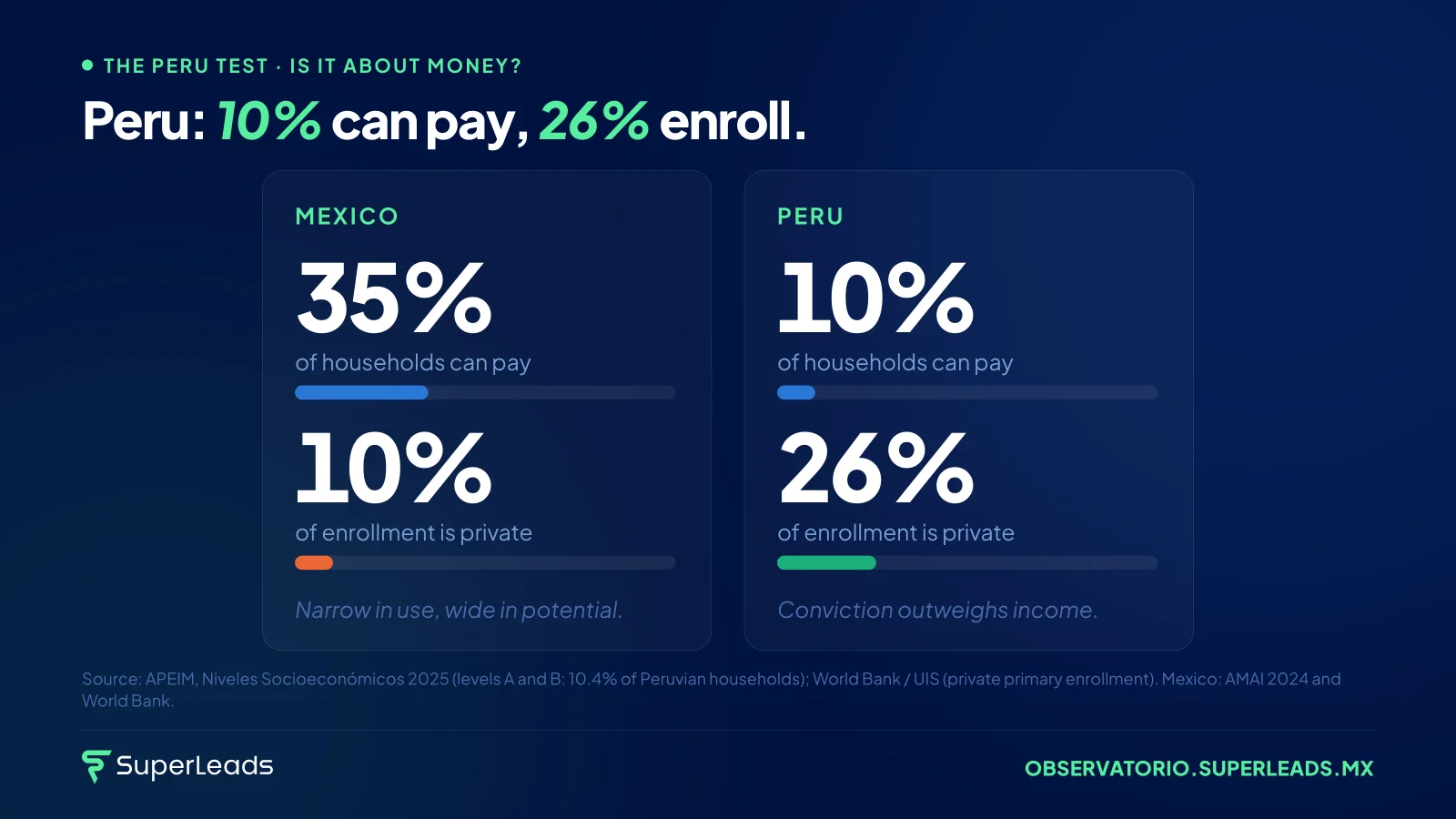
Mexico: 35% can afford it, 10% enroll. Peru: 10% can afford it, 26% enroll. The Peruvian lesson is brutal and liberating at the same time. When a family believes their children’s education is worth it, they find a way to pay for it. The question was never whether they can. The question is who they pay, and why that’s you, or why it’s someone else.
4. A sector larger and more professional than it looks
Official statistics count 45,000 private schools in basic education (preschool through middle school). The figure is inflated for a technical reason any owner knows: each level on a campus gets its own work-center code, the ID SEP assigns to every school, so a school with preschool, primary and middle school shows up three times. Correct for that effect and the real universe is some 20,000 private campuses serving about 5.2 million students. That works out to 260 students per school, the second-highest average in the region.
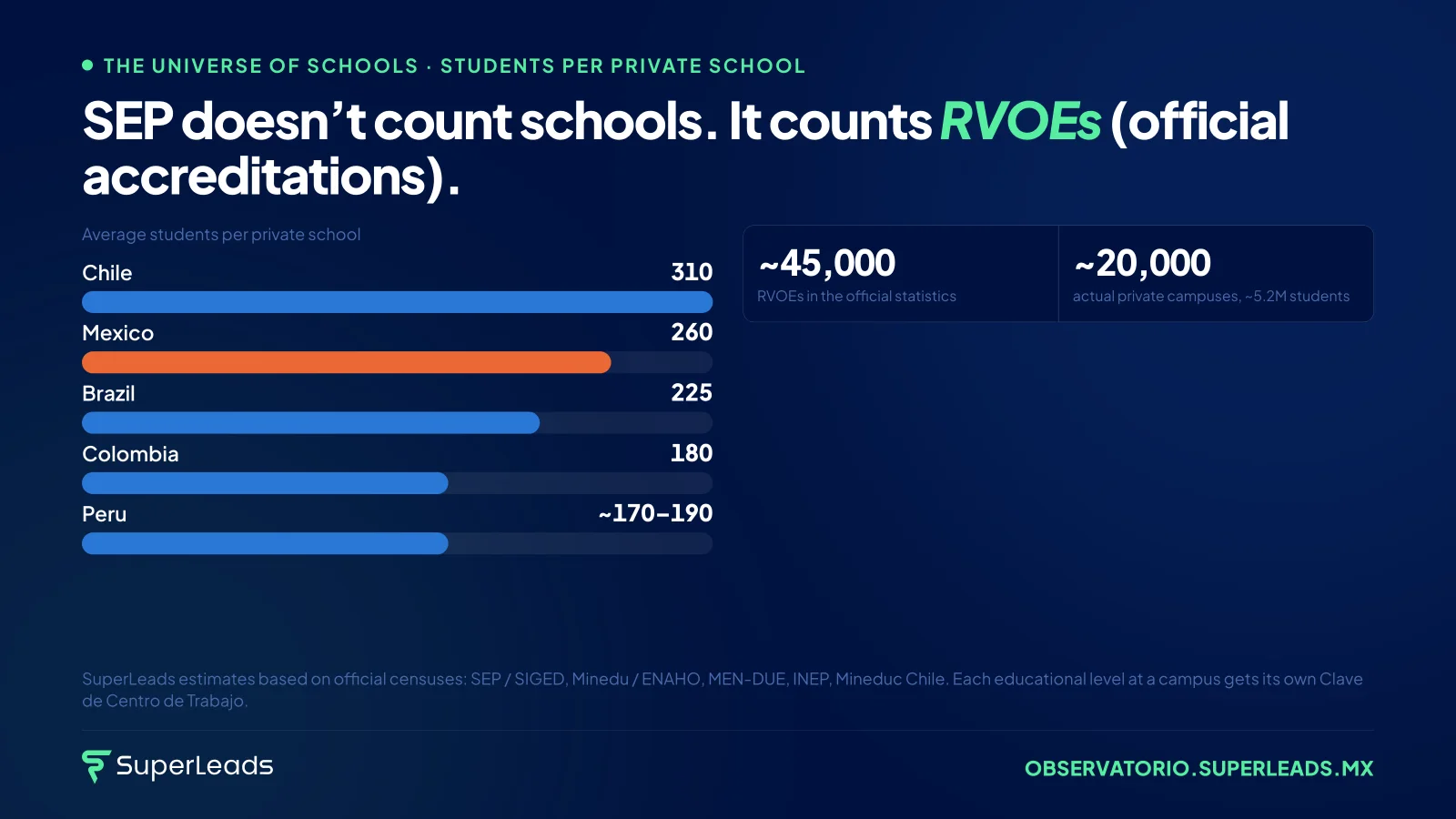
This is not a little school scraping by. It is an operation of 260 families, with annual revenue of several million pesos, a professional teaching payroll and two or three school levels running in parallel. And that last phrase hides the complexity that defines the sector: two or three levels mean two or three admissions processes running at once, which at most schools are handled by the same person who also answers the phone and organizes the school festival.
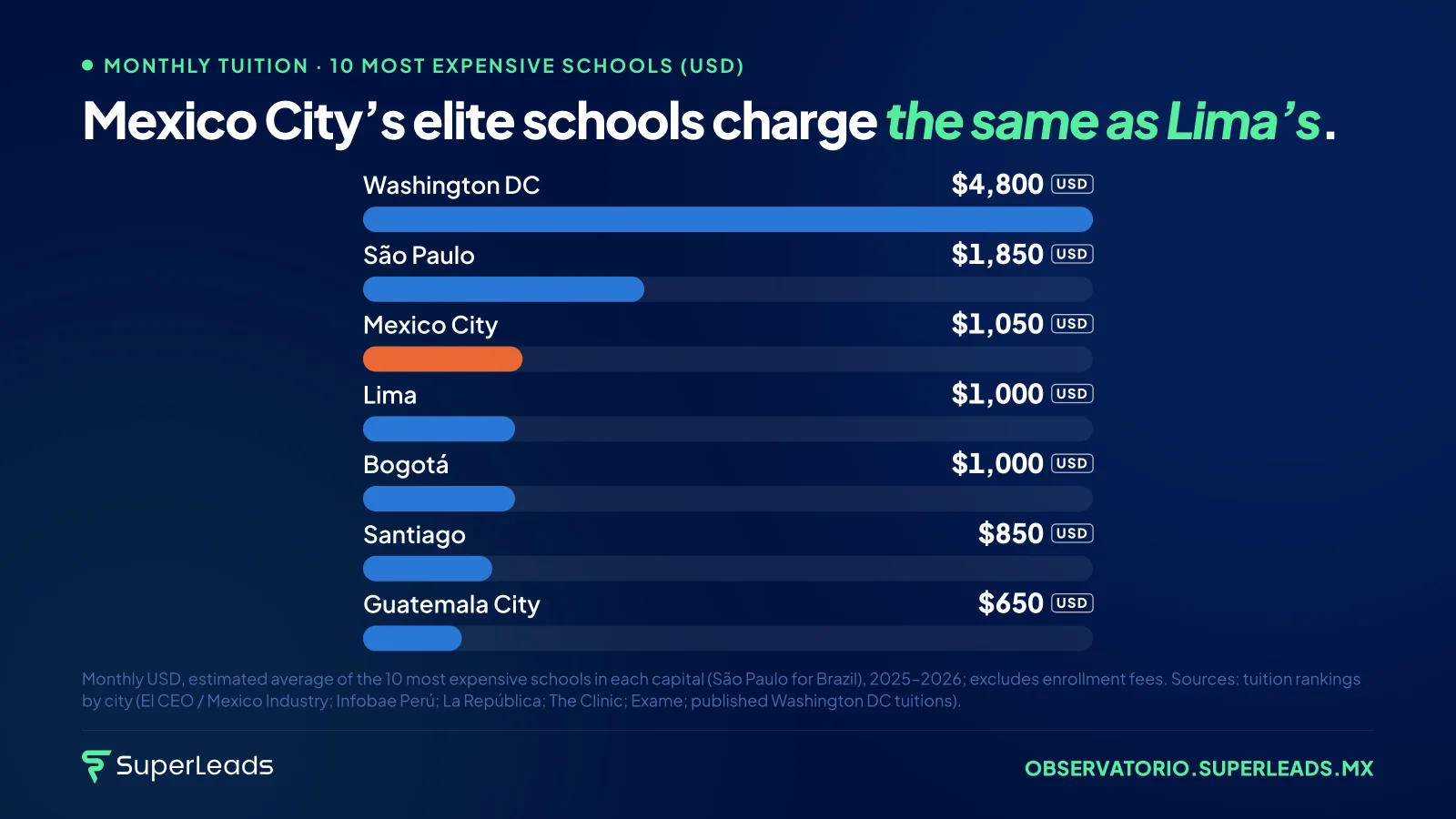
At the top end, the prize can be measured precisely. The ten most expensive schools in Mexico City charge $1,050USD a month on average. That’s the same as in Lima and Bogotá, in a larger economy, and far from São Paulo ($1,850USD) or Washington DC ($4,800USD). Not even Mexico’s premium segment has reached the price its market could bear. It has room to grow in both volume and price: a luxury very few industries can claim.
Demographics are pushing in the same direction. Every year, Querétaro takes in thousands of upper-middle-class families relocating from Mexico City. Mérida draws families looking for safety. Cancún and the Riviera Maya have the youngest population in the country. Monterrey’s industrial periphery, driven by nearshoring, is drawing families with formal incomes and the urgency to choose a school within weeks. Every one of these places receives the easiest families to enroll in the entire market: they aren’t weighing whether to switch schools, they need one now.
5. So why aren’t schools full?
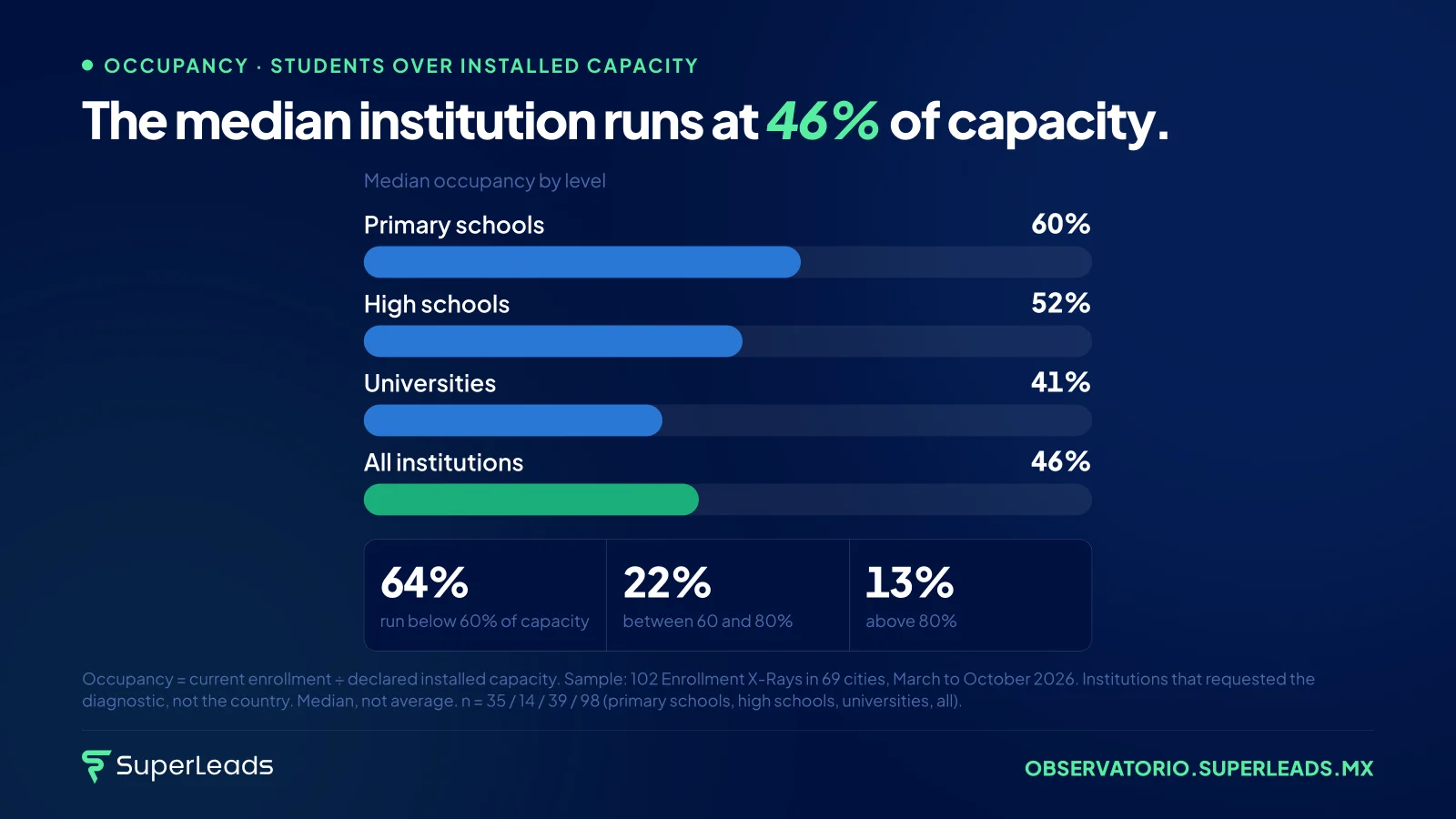
Given all that, every private school in Mexico should be full. Yet the median institution in our October edition operates at 46% of capacity. If the problem were the market, both things could not be true at once. One of the two explanations is wrong, and the data says which.
A school with open seats in a market with demand to spare doesn’t have a market problem. It has a process problem. And that process problem has an anatomy I’ve seen repeat itself across hundreds of diagnostics, with minimal variation. Families do show up: 8 leads a day at the median institution. What decides the school year is what happens in the hours and days that follow.
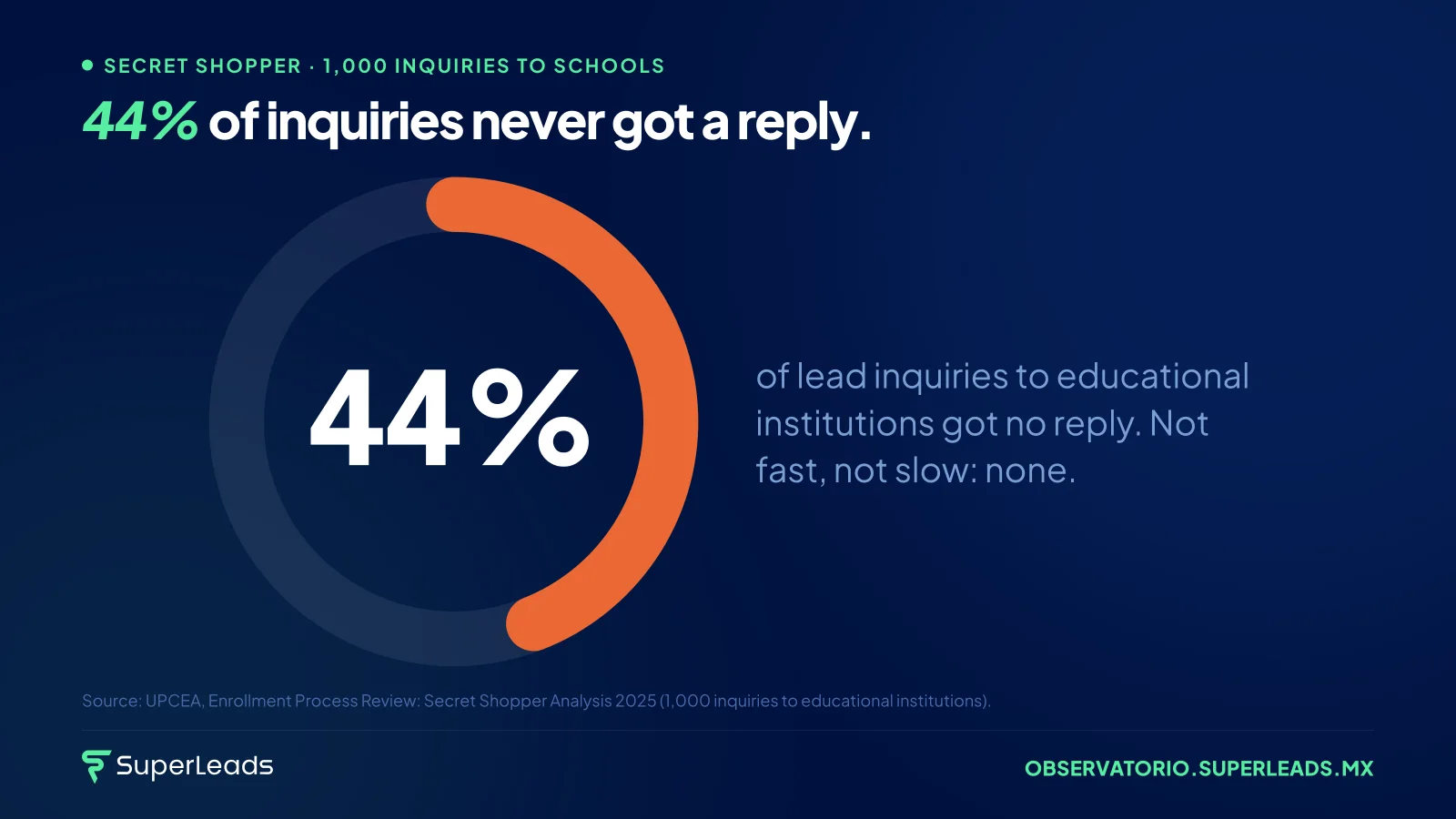
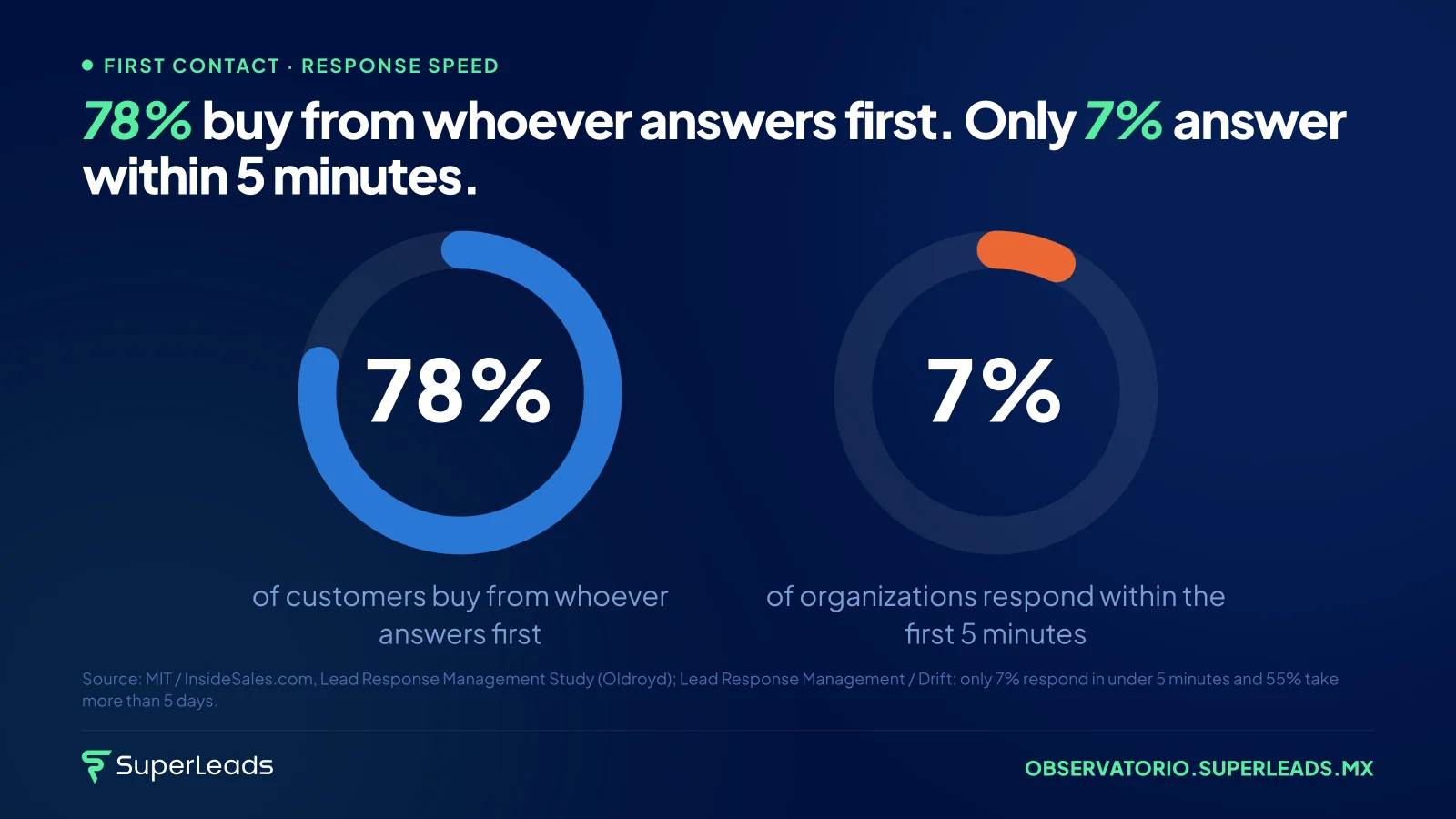
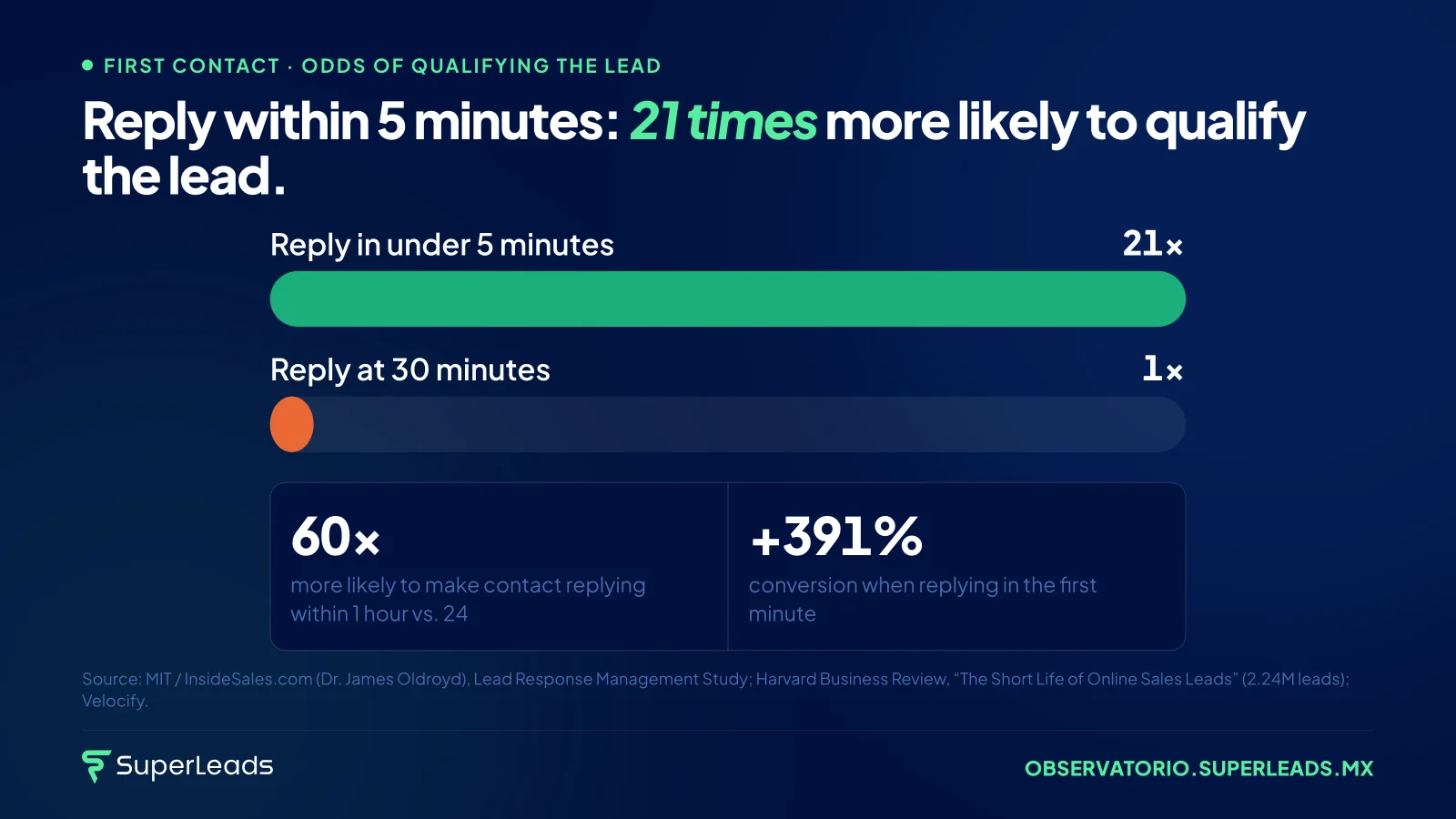
The data on family behavior is unequivocal. In a study of 1,000 inquiries to educational institutions, 44% never received a reply. Meanwhile, 78% of families buy from the first school to respond, and only 7% of organizations respond within the first five minutes. Responding within five minutes makes you 21 times more likely to qualify the lead than responding after thirty.
And families do their research when the school is closed: 93% are online between 9 p.m. and midnight, and 71% rule out a school with fewer than 3 stars on Google. The decision takes six months, and half of it happens without the school ever knowing. Schools compete on a schedule and in a channel that aren’t their own, and whoever shows up with an answer wins the campus visit.
Put a number on it. With monthly tuition of $4,500MXN, a six-year stay and the sibling odds every principal knows, each enrolled family is worth about $450,000MXN. From the same 40 inquiries, the school that responds in hours enrolls 4; the one that responds in minutes enrolls 10. The difference is 6 families: $2.7 millionMXN in lifetime value per enrollment season. They aren’t lost for lack of demand, prestige or advertising. They’re lost to speed.
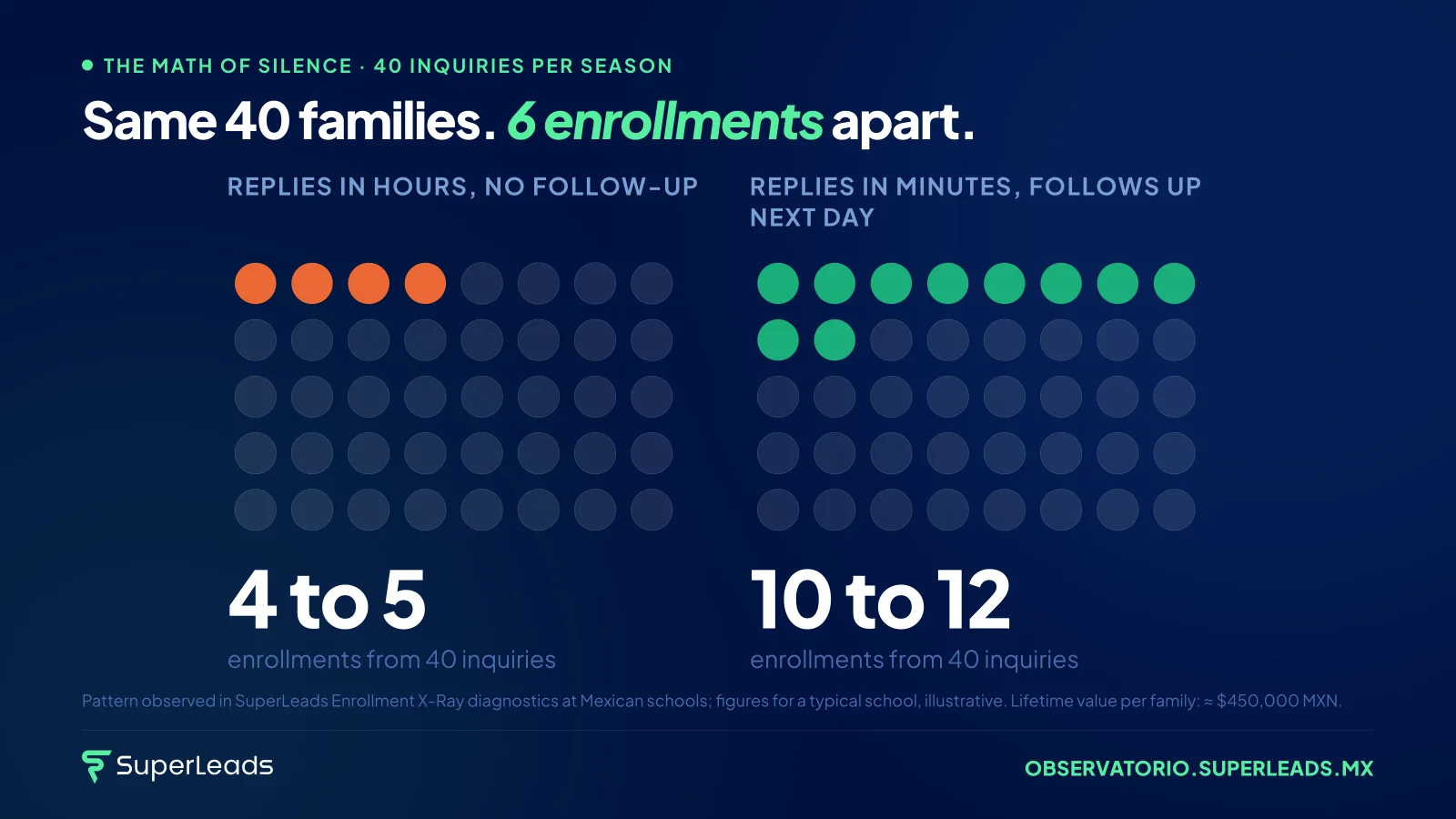
A lost enrollment is almost never a family that said no. It’s a family that said yes with its interest, and was lost to silence along the way.
6. The responsibility
Here I want to change my tone, because this article is not a reproach. The school owners I know work incredibly hard. They invest in advertising, redo their websites, open social media accounts, train their people. And they do something few industries do: they reinvest. I know of no money better spent than what a school owner keeps, because nearly all of it goes back into the school. They’re hooked on improving the lab, the English program, the sports field, the training. These are people with a passion for educating.
That is why it is right, and healthy, for their business model to run at full potential. A profitable school is a school that can reinvest, pay its teachers better and sustain the quality it promises. And if the enrollment system isn’t running at full potential, then the school’s value as an asset and its profitability aren’t either. Enrollment is not a target you chase every August: it is an asset that compounds. Families who are well enrolled stay more years, families who stay refer others, and every school year builds on the last.
Public education, today, is not working. I hope it does someday, and I say that sincerely. But realistically, every child who gets into a good private school is pulled out of the 66% statistic, out of the 86% with no English teacher, out of the June strikes. That is what a school owner does when they fill a classroom. That’s why I say they need to be more ambitious: not for their own sake, but for the country’s. And best of all, they can grow enormously without taking a single student from anyone. With 13.4 million households that can afford it and 10% penetration, every family that crosses over from public to private is brand-new demand that belonged to no one before. The school that learns to convert those families isn’t fighting over the pie. It’s baking a bigger one.
7. How it’s done: model, system, scale
What schools need isn’t a stronger calling or more effort. It’s knowing how to sell themselves, and selling well is a system, not a season. The sequence I’ve seen work is always the same.
- First, review the business model. Capacity, enrollment, tuition, retention, the lifetime value of a student, the cost of each new student. It comes down to ten numbers, and most schools don’t have them at hand. Without them, every sales decision is a hunch.
- Next, set the parameters of the enrollment system. Every stage of the funnel gets an owner, a maximum response time and a measured conversion rate. Every lead is tracked from the first message to the signed enrollment, without depending on anyone’s memory. The bottleneck shows up on a dashboard instead of being discovered in August.
- And with that, you scale. The same number of interested families produces more enrolled students. The system doesn’t change how many families arrive; advertising does that. It changes how many stay, and no advertising budget can buy that.
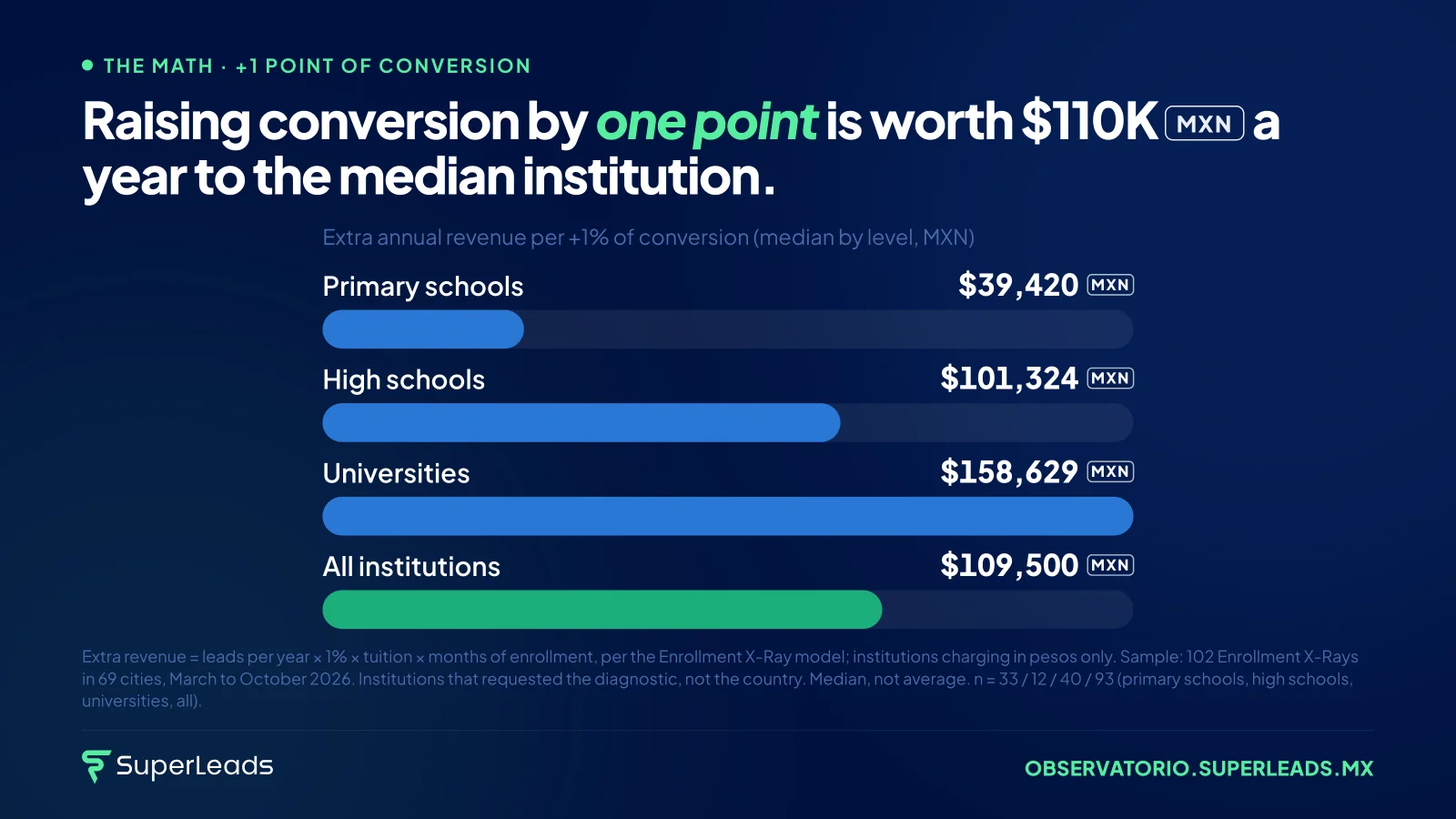
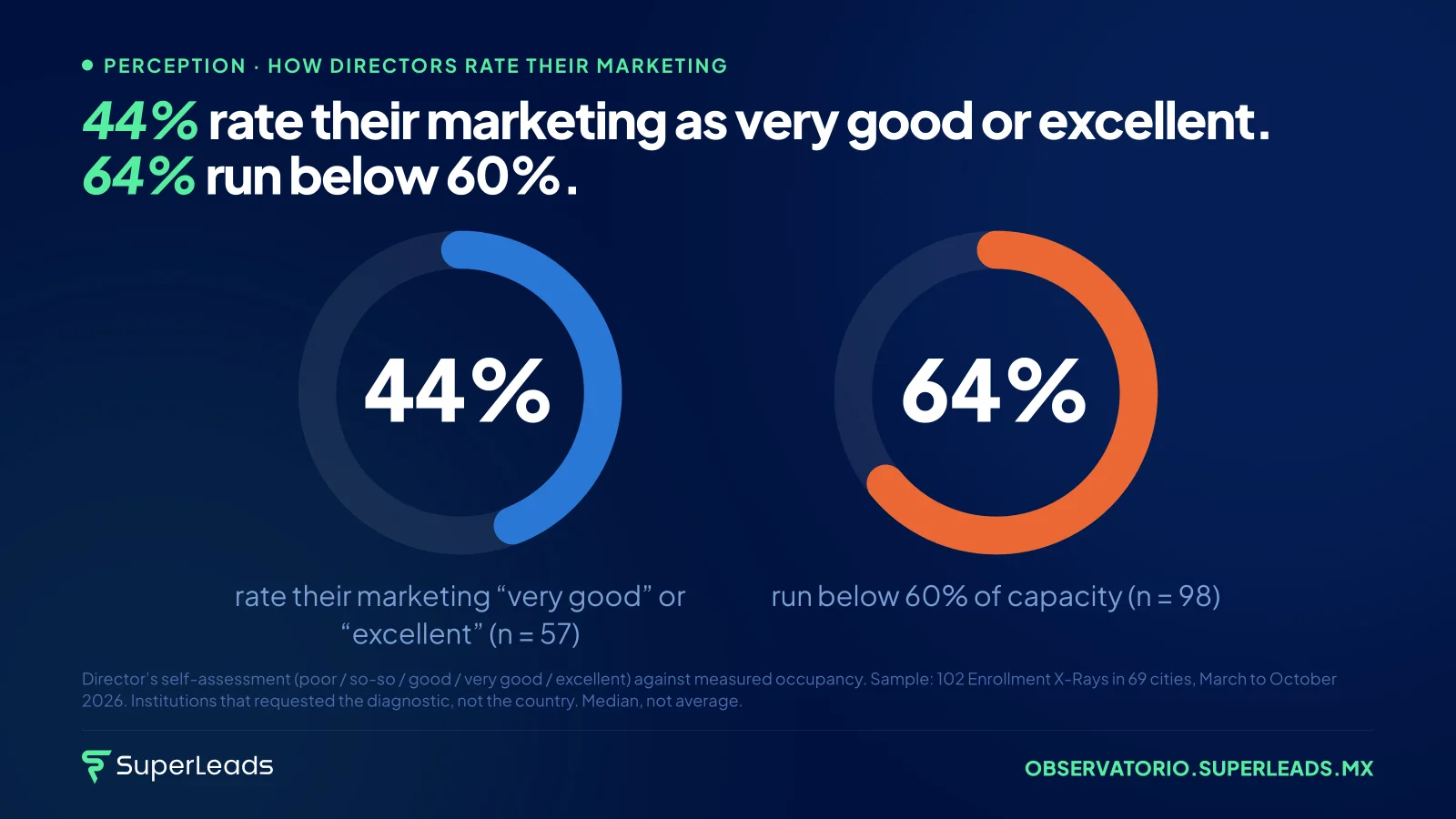
In the October edition, raising conversion by a single point is worth $109,500MXN a year to the median institution. It’s the cheapest growth there is, because the families have already arrived. And the gap between what directors believe and what they measure (44% rate their marketing as very good while 64% operate below 60% occupancy) is the first thing that closes once the numbers are on the table.
Conclusion
The market has done its part. The families exist, the purchasing power exists, demographics are pushing in the right direction and supply has room to grow. The missing piece doesn’t happen in the market: it happens inside each institution, in the quiet stretch between the first “Good afternoon, I’d like some information” and the signed enrollment form.
Life is easier when you have technology, methodology, support and strategy in place at your school. Not because they take work off your plate, but because the work stops depending on memory, on one person’s phone and on the luck of the season. That’s what I do at SuperLeads, and it’s what we do in every Enrollment X-Ray: in a single session, we put the school’s numbers in the order they need to be in and finally see where the leak is, what’s causing it and what to fix first.
If you run a school, I ask just one thing of you after reading this: be more ambitious. The country needs your school full. And if you’d like to talk it over with me, write to me: ricardo@superleads.mx.
Sources
World Bank, private primary enrollment (indicator SE.PRM.PRIV.ZS); UNESCO UIS, enrollment by type of institution (public/private); AMAI, Regla NSE 2024; INEGI, ENIGH; APEIM, Niveles Socioeconómicos 2025 (Peru); SEP / SIGED, catalog of work-center codes and RVOE (official accreditation); Minedu Peru, INEP Brazil, Mineduc Chile, MEN Colombia, NCES; 2025–2026 tuition rankings for Mexico City, Lima, Bogotá, Santiago, São Paulo, Guatemala and Washington DC; IMCO, Índice de Competitividad Urbana 2026; CONAPO, UN-Habitat; UPCEA, Enrollment Process Review: Secret Shopper Analysis 2025 (1,000 inquiries to educational institutions); MIT / InsideSales.com, Lead Response Management Study (James Oldroyd); Harvard Business Review, “The Short Life of Online Sales Leads”; Asociación de Internet MX, Estudio de Hábitos de Usuarios de Internet en México; BrightLocal, Local Consumer Review Survey 2024–2026; Northwestern University / Spiegel Research Center; Shortway, Marketing para escuelas privadas, Guía 2026; Think with Google / SEMrush; SuperLeads, Enrollment X-Ray edition of October 29, 2026 (102 institutions, 69 cities). Estimates of physical campuses and per-school averages by SuperLeads, based on official censuses. Full methodology available on request: ricardo@superleads.mx.
SuperLeads Observatory · October 30, 2026