
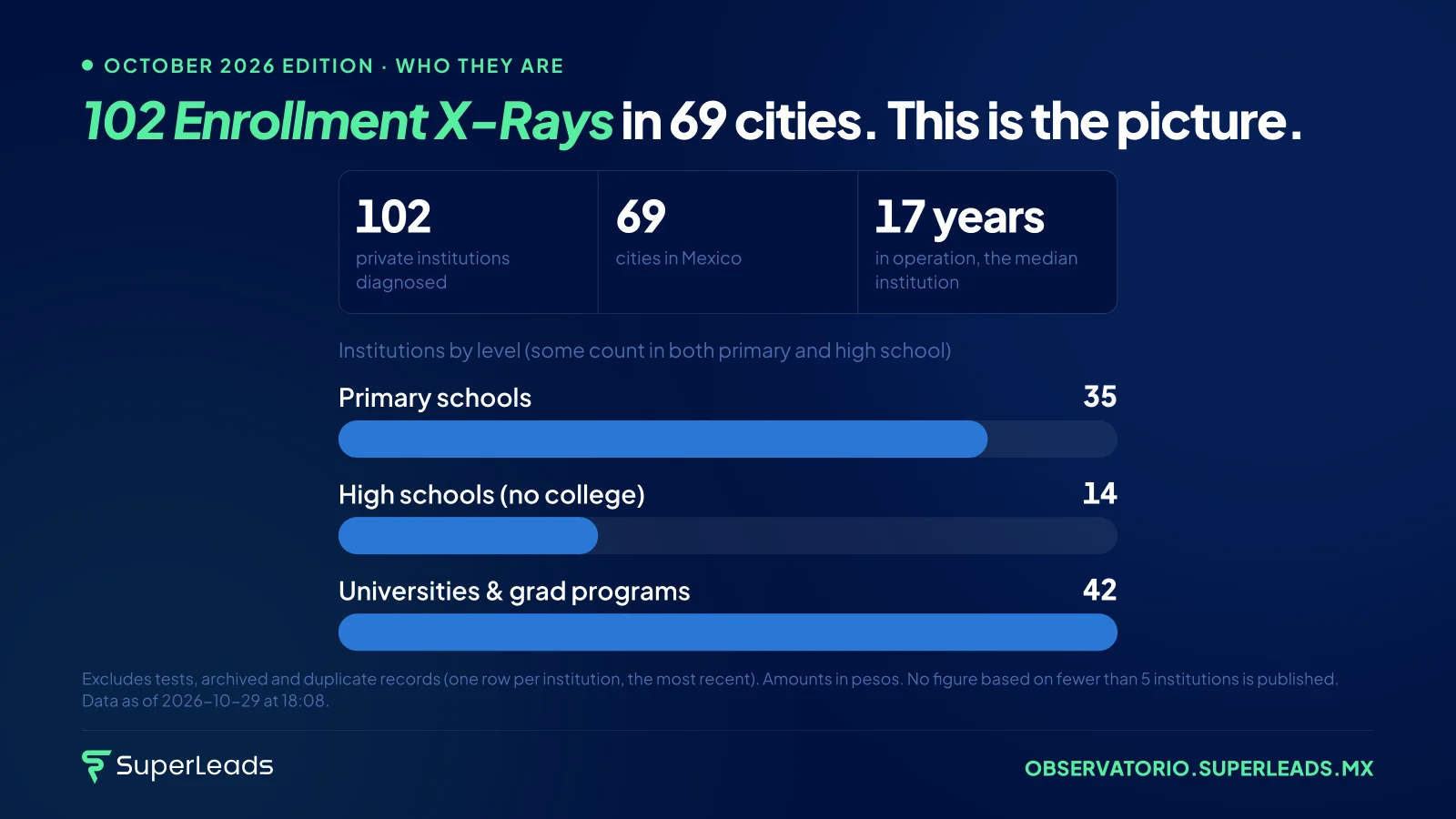
Between March and October 2026, my team and I sat down with 102 owners and directors of private educational institutions in 69 cities across Mexico. With each of them we did the same thing: an Enrollment X-Ray. One session to lay out the institution’s admissions numbers the way they should be laid out: capacity, enrollment, leads, campus visits, new enrollments, tuition, retention, advertising, team.
This article is the first edition of those numbers. I’m publishing it because I believe the sector needs a benchmark that doesn’t exist today: when a director wants to know whether their school is doing well or badly, there is no one to compare against. They compare with last school year and with what they hear in the hallway. Here is something better: the median of 102 institutions measured with the same yardstick.
Two caveats before we start, because I want this to be citable. First: this is our sample, not the country. These are institutions that asked for a diagnostic: 35 primary schools, 14 high schools, and 42 universities and graduate programs, plus academies and online schools. Second: I publish medians, not averages. A school with 7,000 students skews the average and makes it lie. The median tells you where the typical school sits, and that is what you need to see where you stand.
1. Half the school is empty
The first finding is the one I find hardest to say out loud: the median private institution in Mexico operates at 46% of its installed capacity. That isn’t a school in crisis. That’s the midpoint of the sample. Of every 100 seats it built, it uses 46.
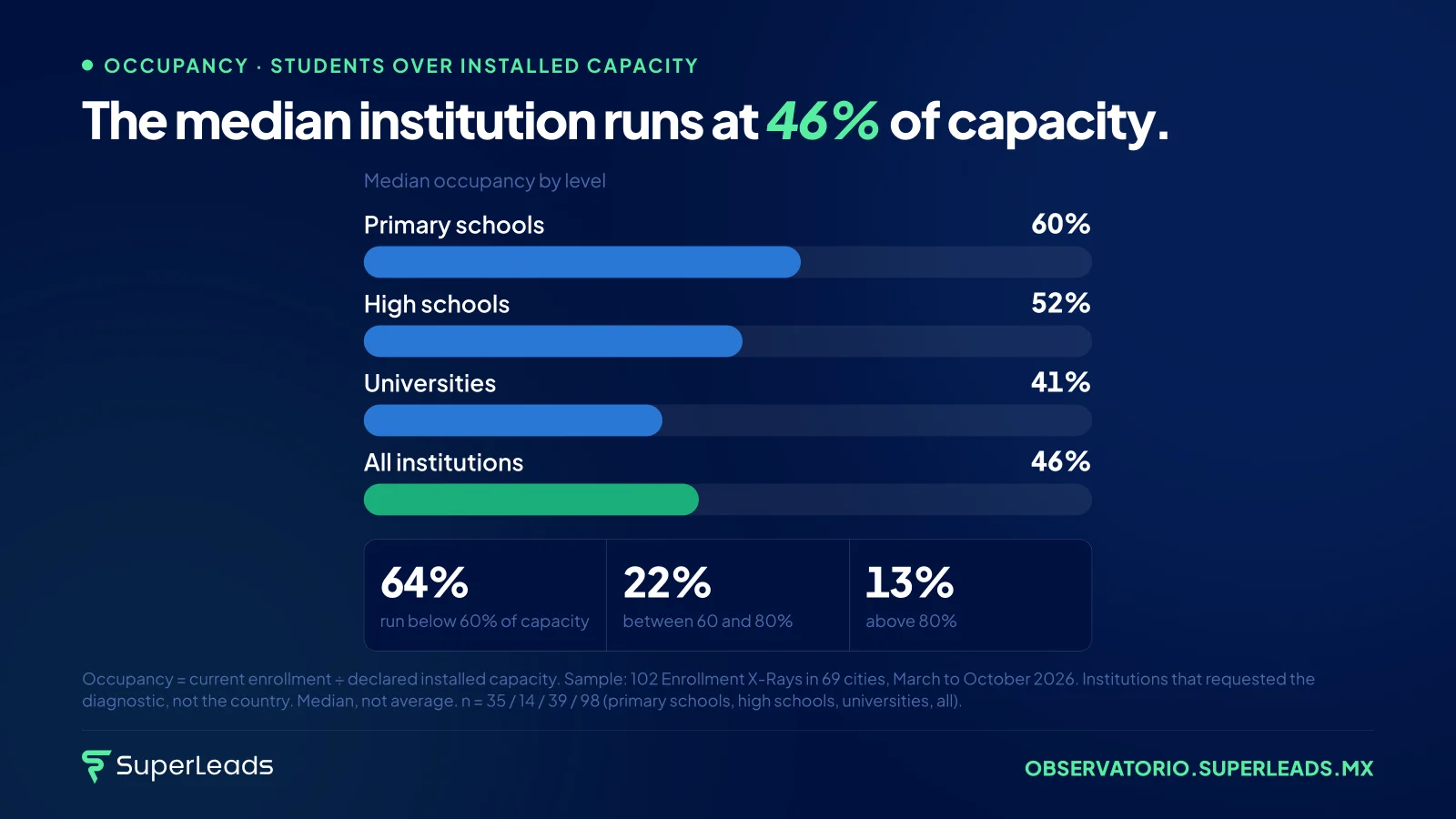
By level, the picture barely changes. Primary schools run at 60% at the median, high schools at 52% and universities at 41%. Six in 10 institutions in the sample sit below 60% occupancy; only 13% are above 80%.
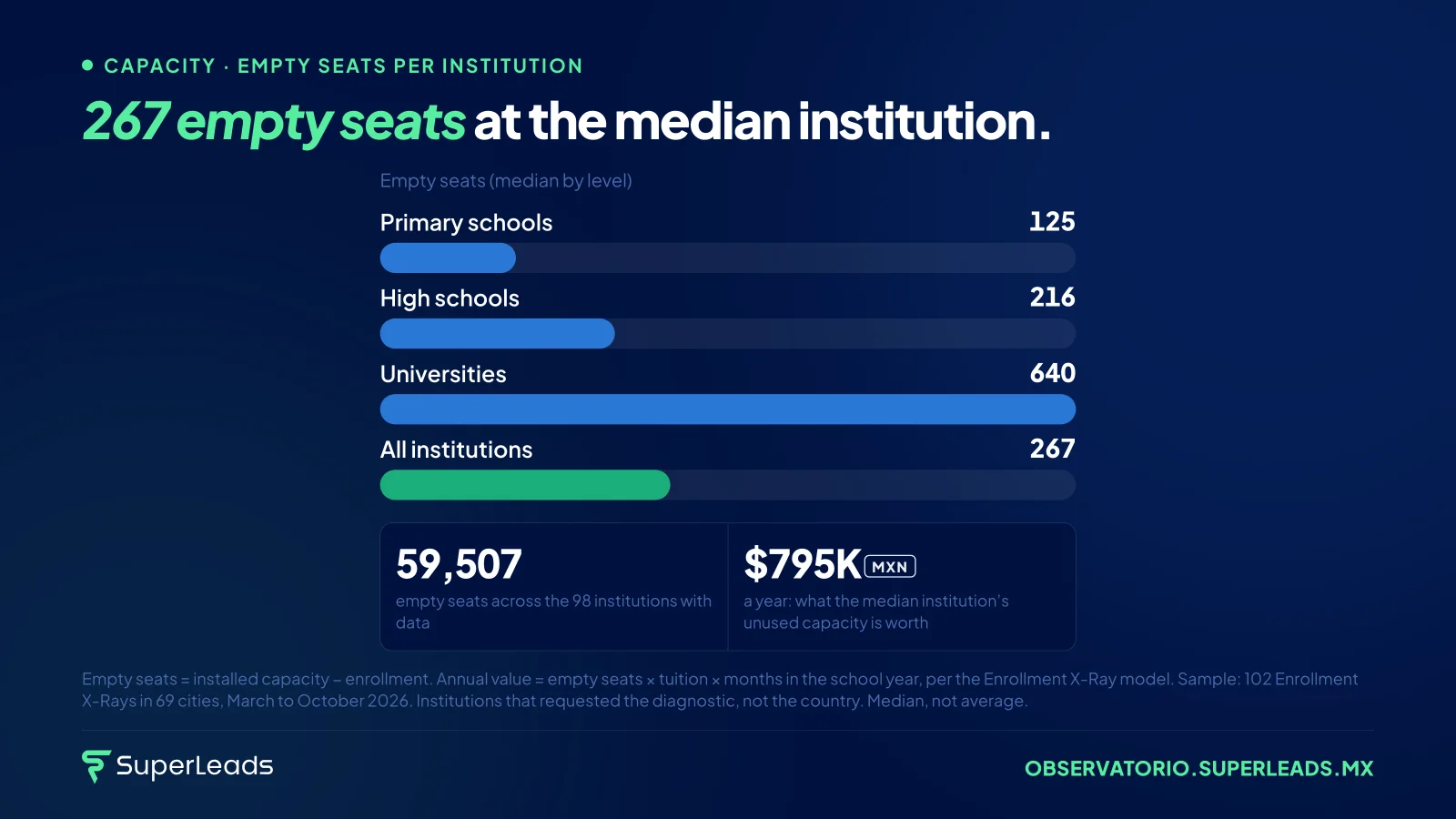
Counted in seats, the median institution has 267 empty chairs. Across the 98 institutions that reported the figure, that adds up to 59,507 seats without a student. Counted in pesos, the median institution’s unused capacity is worth $794,625MXN a year; across all of them, $279.6 millionMXN a year. This is infrastructure that has already been paid for: the classroom exists, the teacher exists, the seat exists. The only thing missing is the student.
What strikes me most isn’t the number but how normal it has become. Nobody opens a school to fill it halfway. You get there one school year at a time, with one family that never answered and another that showed up late for the visit. And because the decline is slow, nobody treats it as an emergency.
2. The funnel: where enrollments get lost
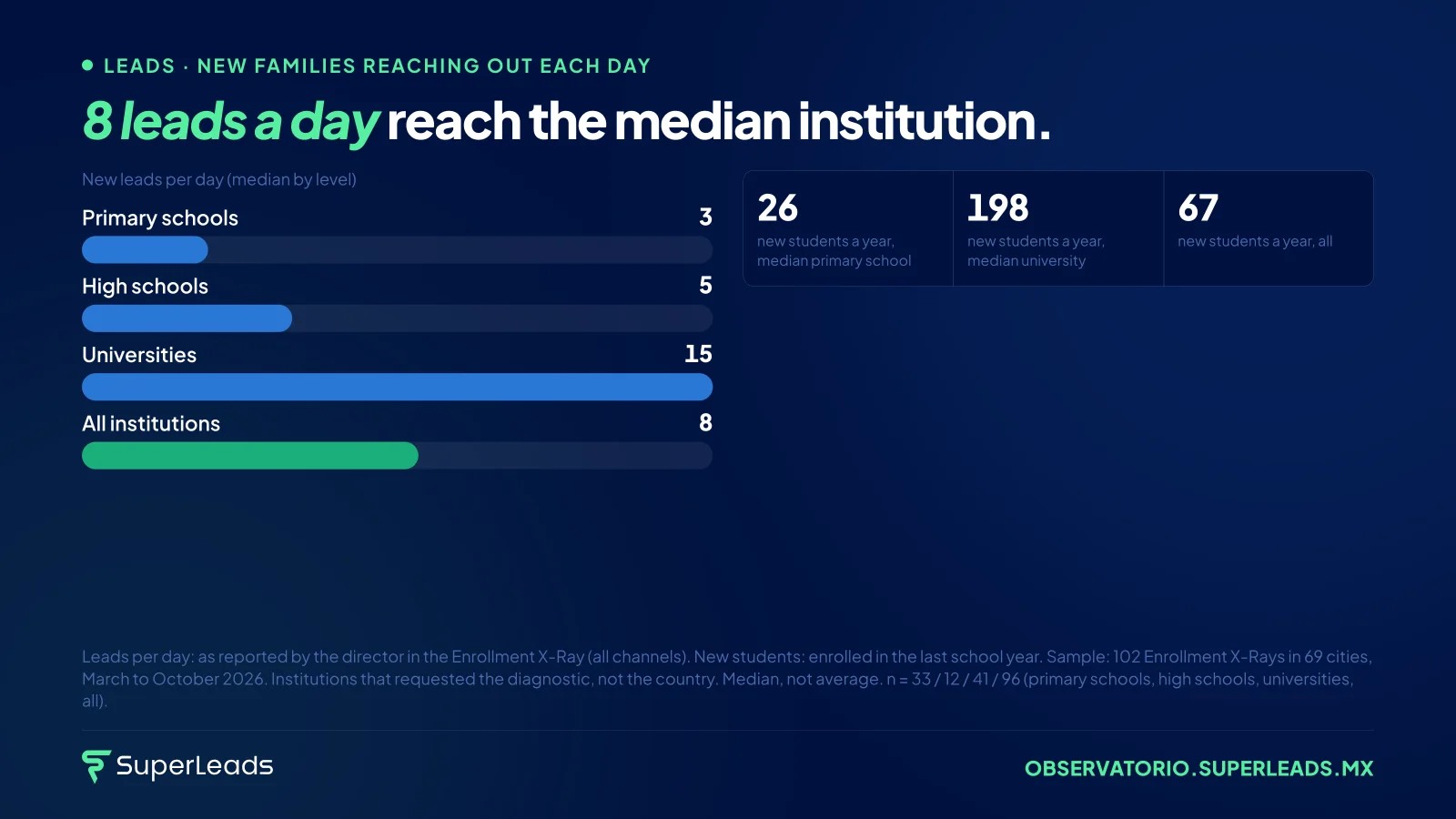
The median institution receives 8 new leads a day. Primary schools get 3, high schools 5 and universities 15. That isn’t weak demand: it’s between 60 and 400 families a month raising their hand.
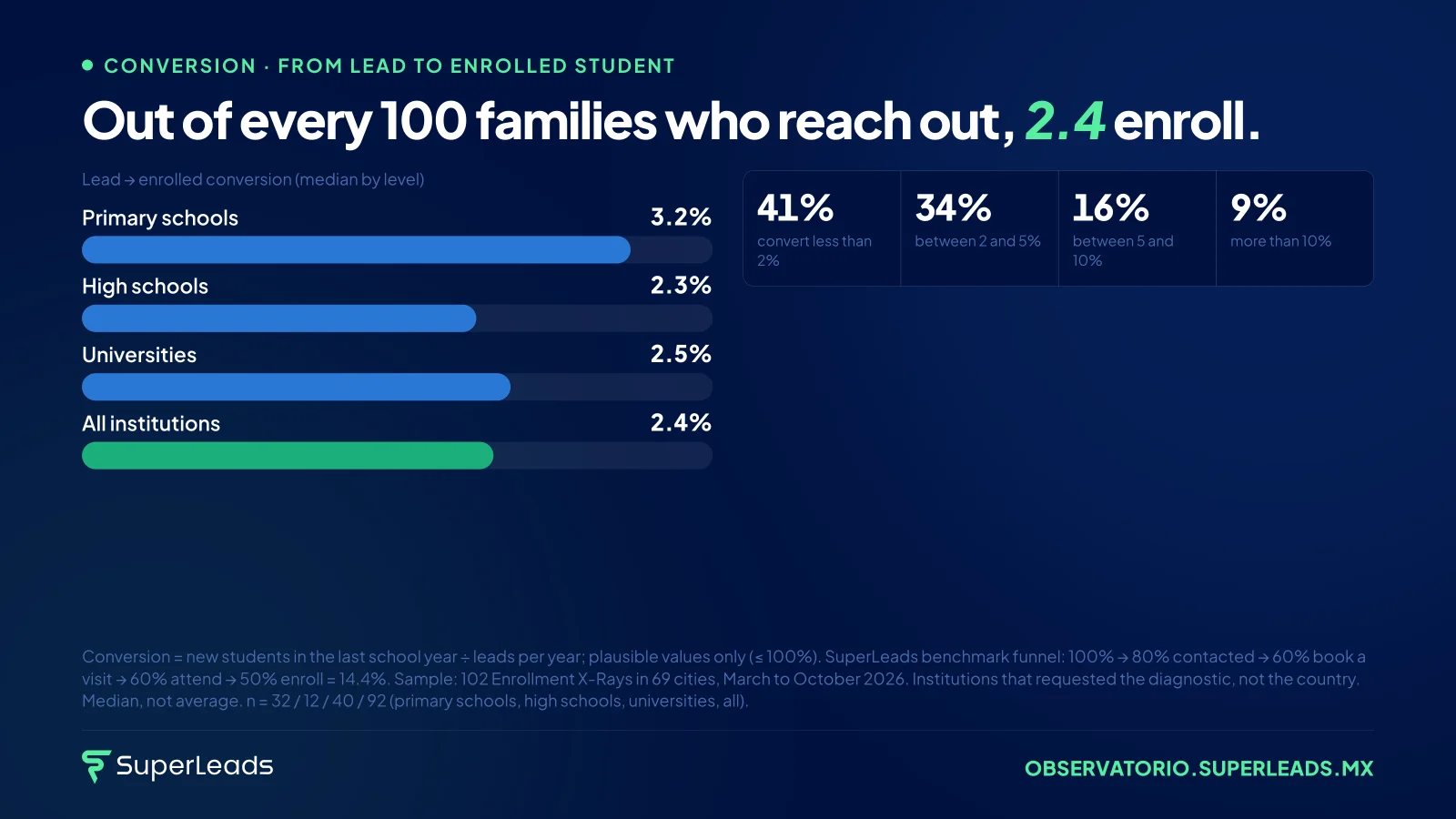
Out of every 100 families that inquire, 2.4 enroll. That is the median lead-to-enrollment conversion rate. Four in 10 institutions convert less than 2%. Only 9% convert more than 10%.
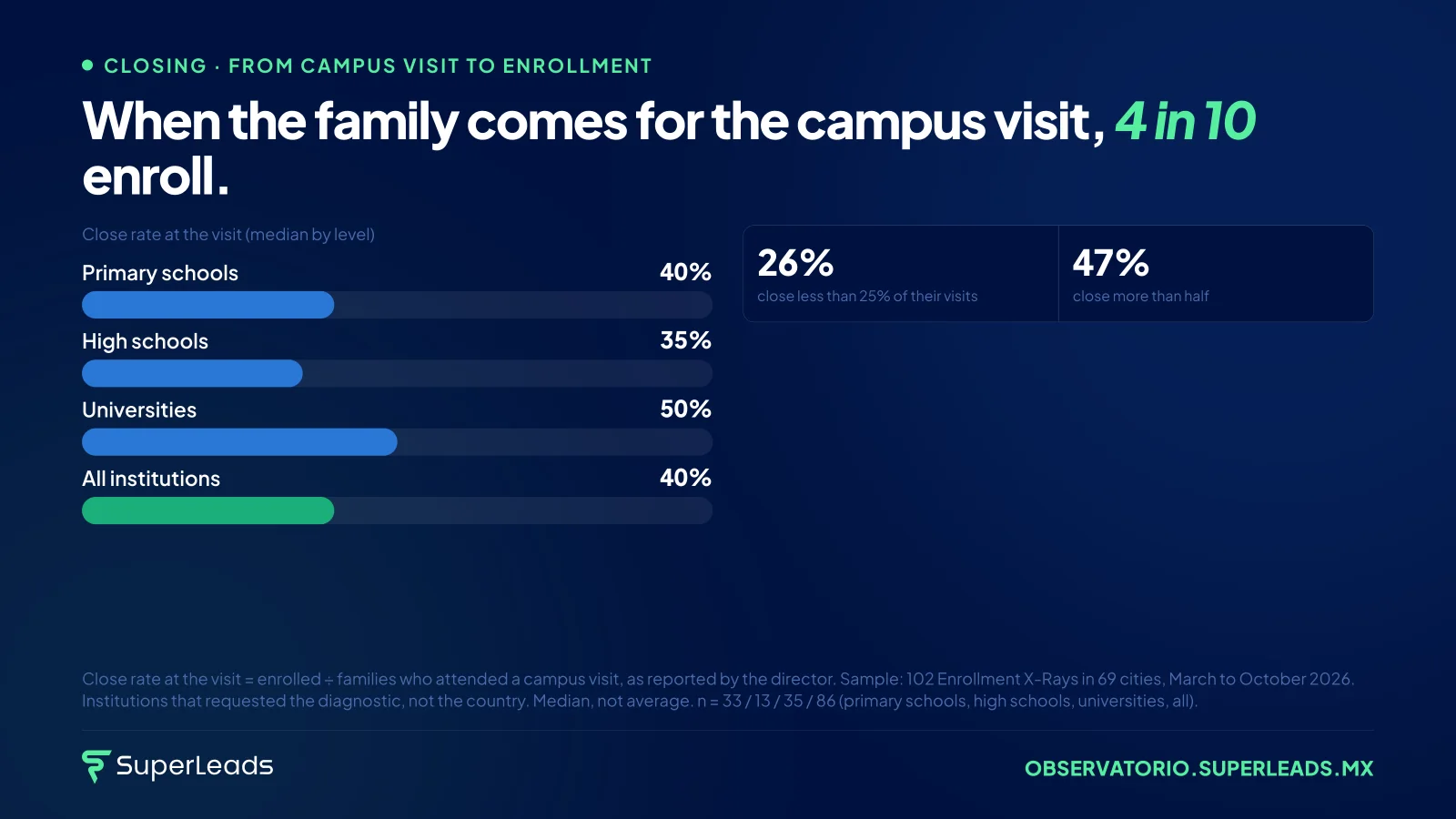
And here is the figure that changes the diagnosis. Of the families who do make it to the campus visit or tour, 40% enroll. In other words: when the school has the family in front of it, it sells. What it doesn’t know how to do is get families there.
Taken together, those three figures say something uncomfortable and very useful. The problem for Mexico’s private schools isn’t the campus visit. It sits before the visit: in how long it takes to answer the first message, in the follow-up on day two, in the “I’ll get back to you in a minute” that turned into never. Most of the demand evaporates between the first WhatsApp message and the campus tour, and almost never because of price.
3. The money: what a student is worth and what one costs
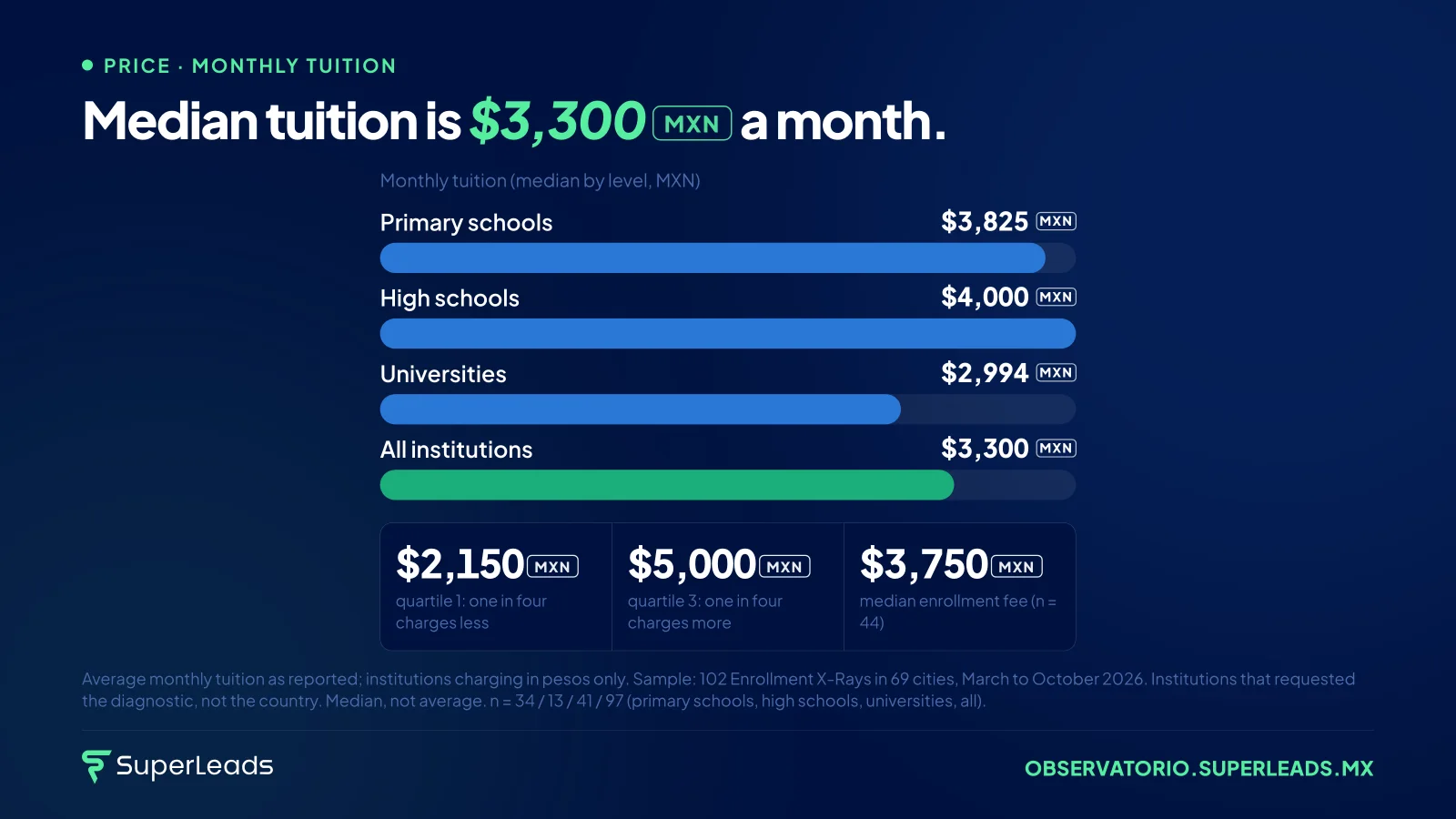
Median monthly tuition is $3,300MXN. Half of institutions charge between $2,150MXN and $5,000MXN a month. Primary schools charge $3,825MXN at the median, high schools $4,000MXN and universities $2,994MXN. The median enrollment fee is $3,750MXN.
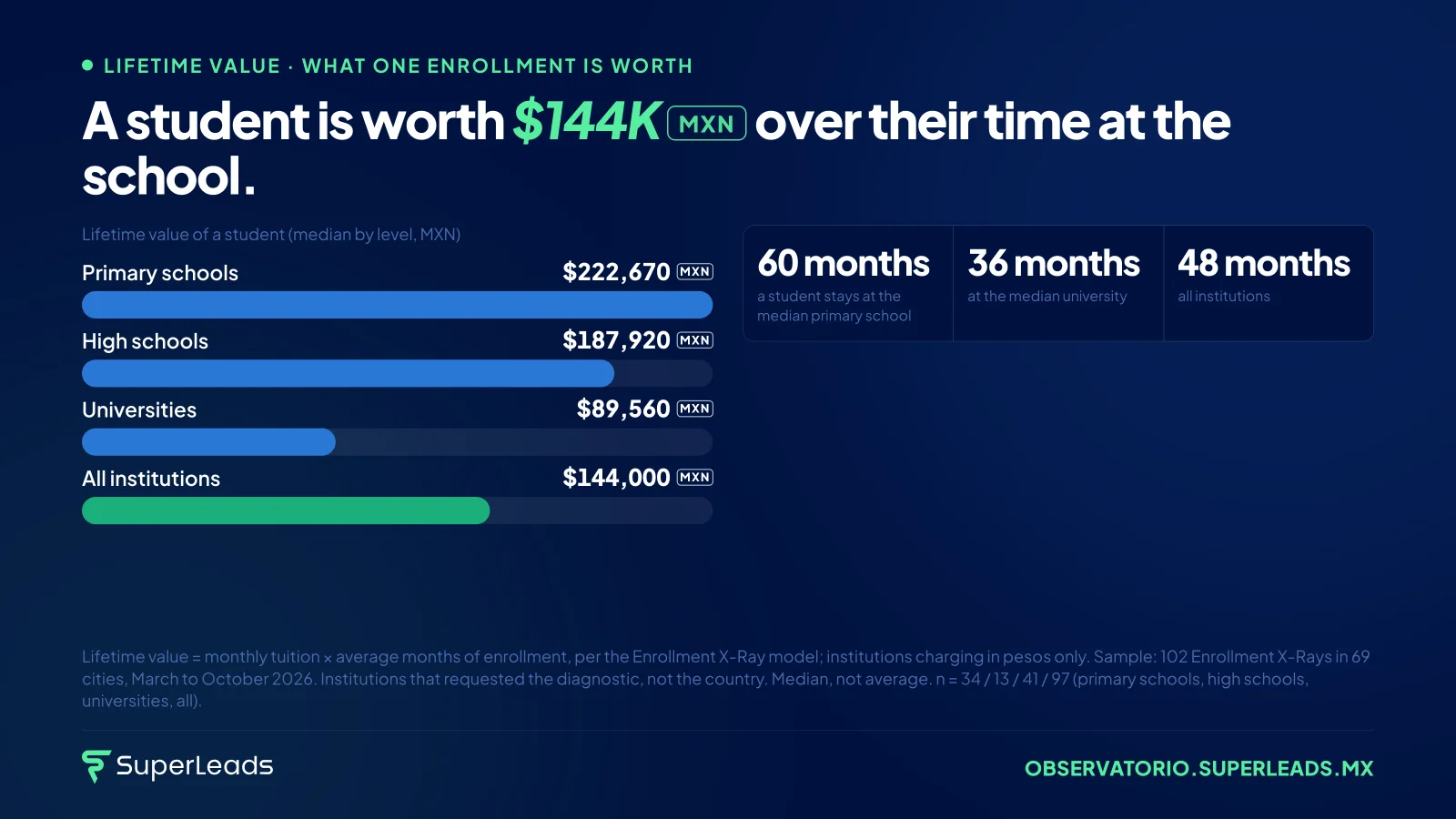
A student stays 48 months at the median institution: 60 months at primary schools, 60 at high schools, 36 at universities. Tuition times months of retention gives you lifetime value: $144,000MXN per student at the overall median, and $222,670MXN at primary schools. Every family that enrolls is worth that. So is every family that goes cold.
On the other side of the ledger is cost. The median institution spends $8,000MXN a month on advertising: $3,250MXN at primary schools, $6,083MXN at high schools, $14,000MXN at universities. Each lead costs it $41MXN, and each enrolled student $1,381MXN.
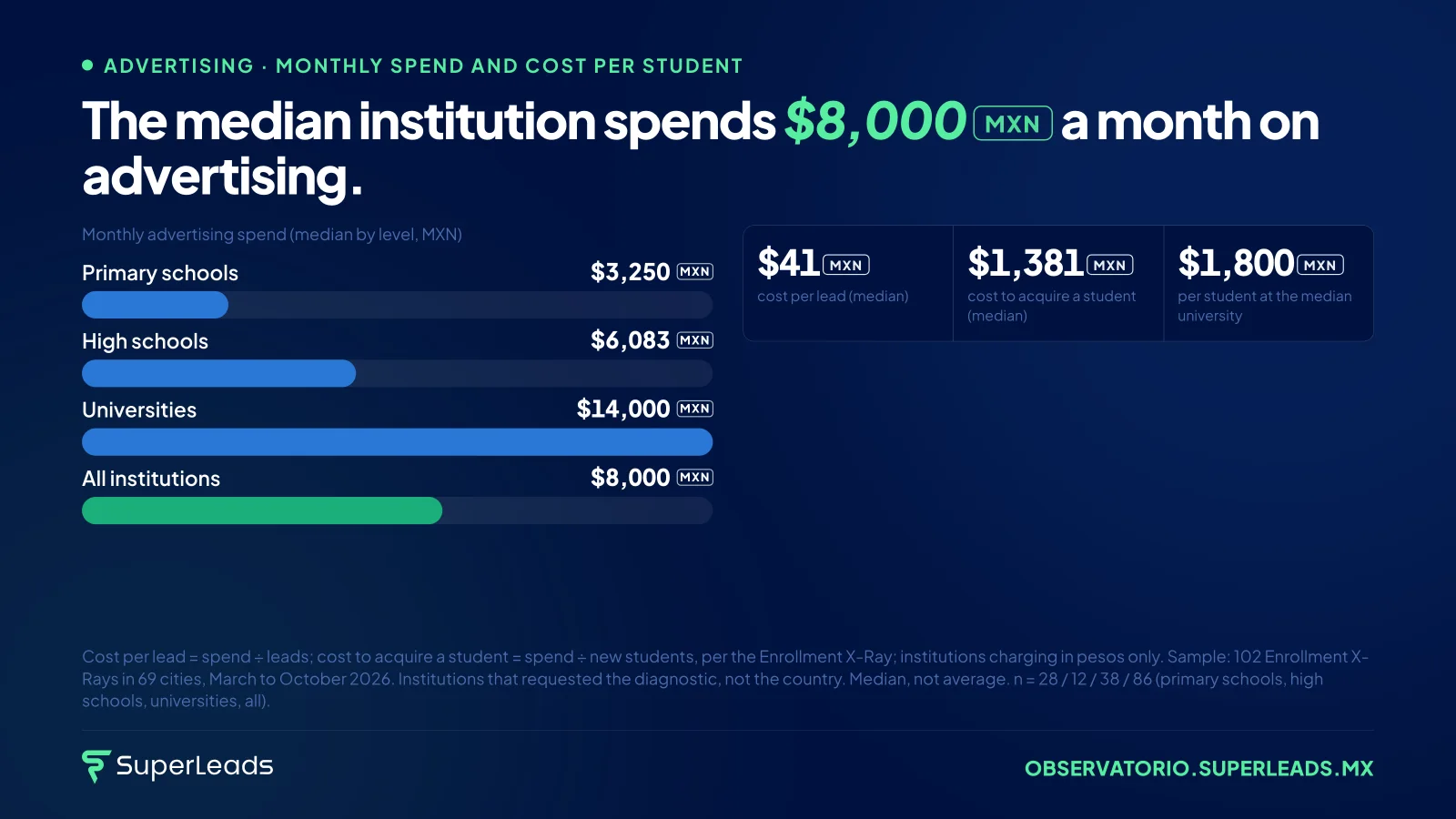
Read those side by side: a student costs $1,381MXN and is worth $144,000MXN. Education advertising is one of the most profitable investments I know. The problem has never been how much gets spent, but how much of what that spending buys evaporates afterward, without anyone noticing.
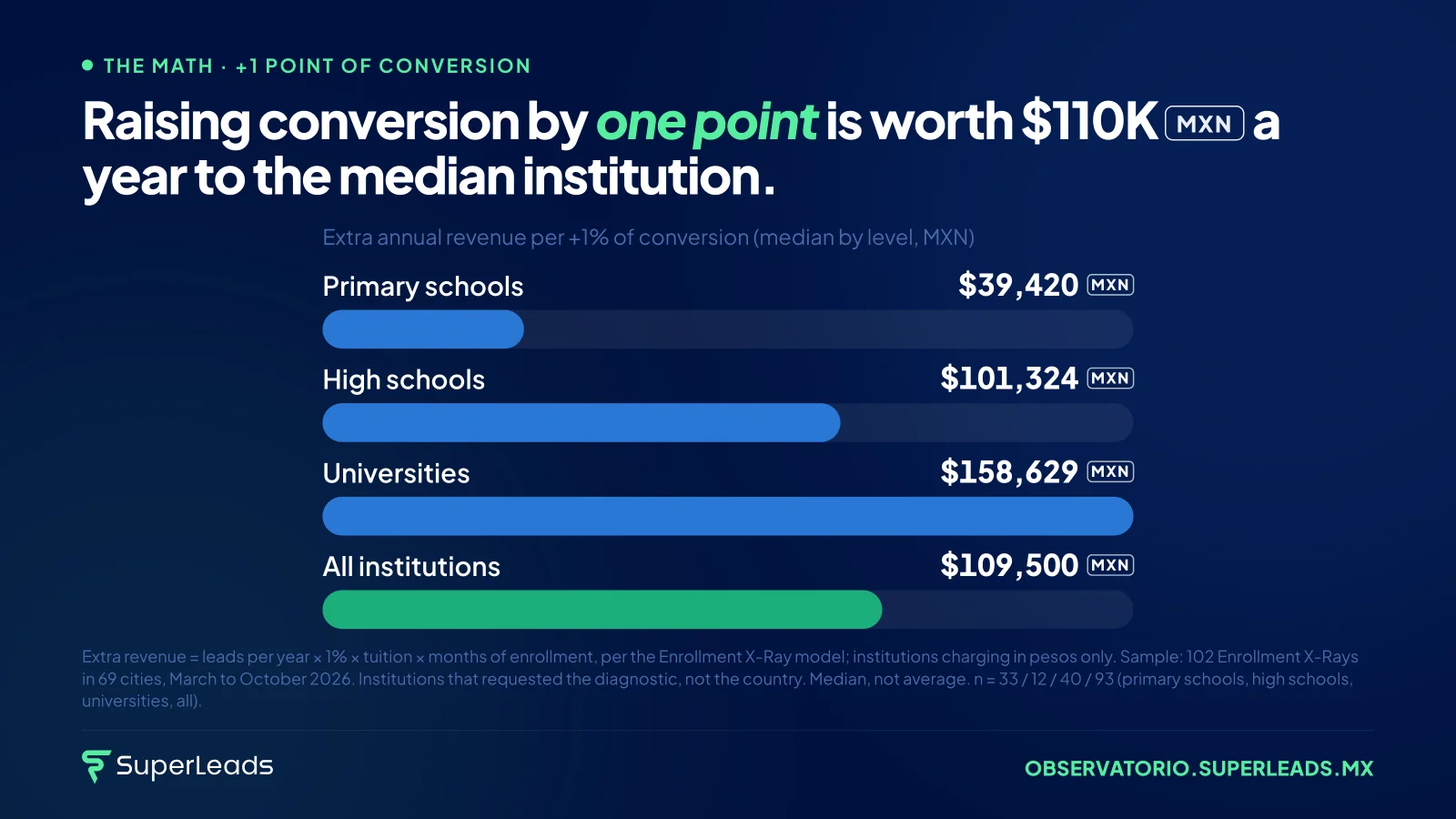
That’s why the figure I repeat most in every Enrollment X-Ray is this one: raising conversion by a single percentage point is worth $109,500MXN a year to the median institution. $39,420MXN for the median primary school, $101,324MXN for the median high school and $158,629MXN for the median university. Without one more peso spent on ads. The same number of interested families, better served.
4. How the admissions operation is built
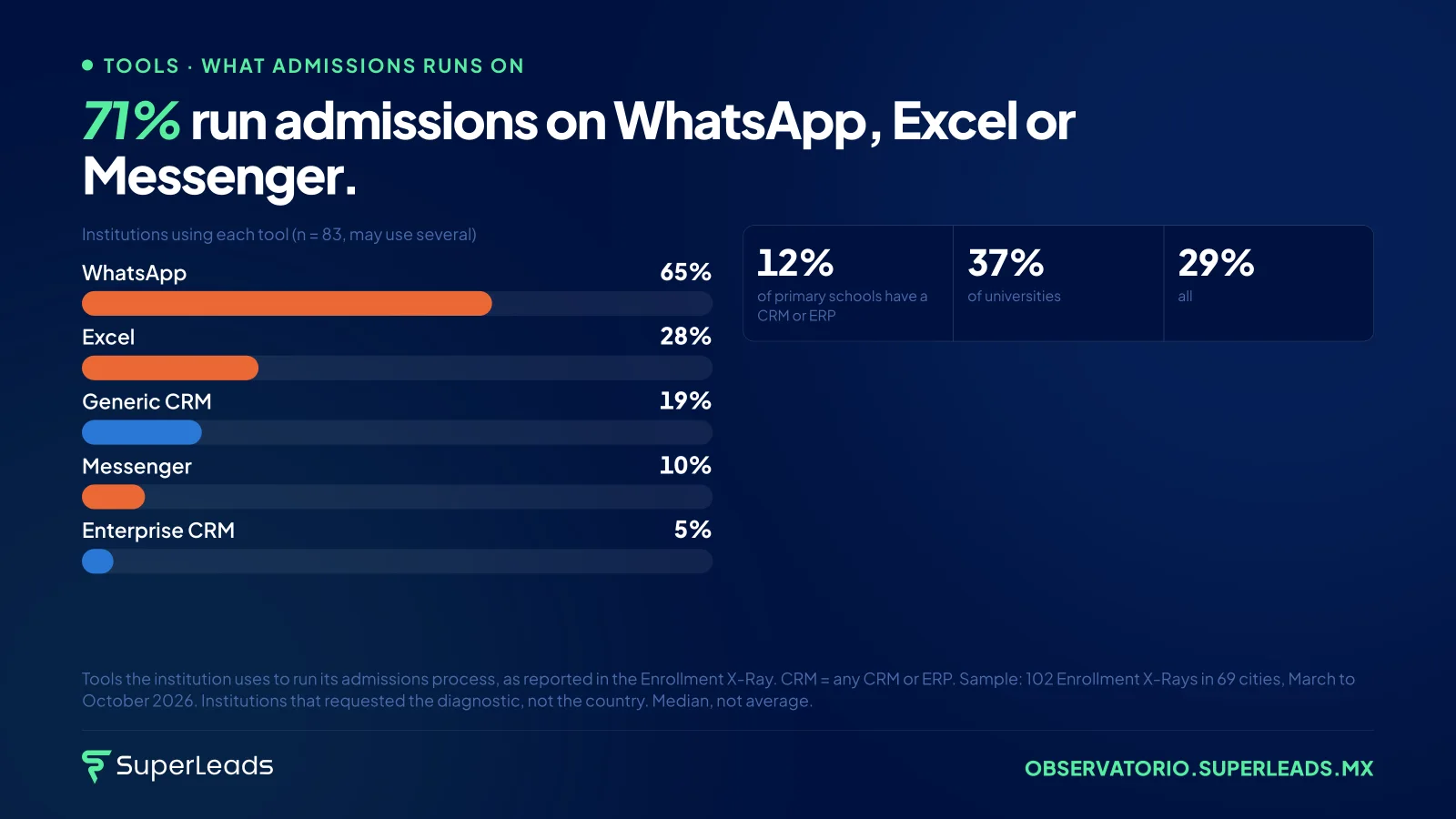
Here is the explanation for almost everything above: 71% of institutions run their admissions on WhatsApp or Excel. Only 29% have a CRM. Among primary schools, 88% work with WhatsApp and Excel and just 12% have a CRM.
The median institution’s admissions and marketing team is 3 people; at primary schools, 1.1 people. The median number of dedicated admissions advisors is 1; at primary schools, zero. Only 55% of institutions have someone with the title of admissions director, and 24% work with an outside agency.
And 48% of institutions have no compensation plan for their admissions team; among primary schools, 61%. In other words, the person who decides whether a family enrolls almost never has an incentive tied to enrolling them.
All of this happens in a very short season. For half of institutions, enrollment is concentrated in July and August; for four in 10, in February. A high-season operation, staffed by one person, with its memory on a phone and no incentive. It isn’t a lack of talent. It’s a lack of a system.
5. The levers almost nobody pulls
Scholarships are offered by 68% of institutions, and at the median 40% of students hold one, with an average scholarship of 25%. The scholarship is no longer the exception: it is a sales tool, and it should be managed as one.
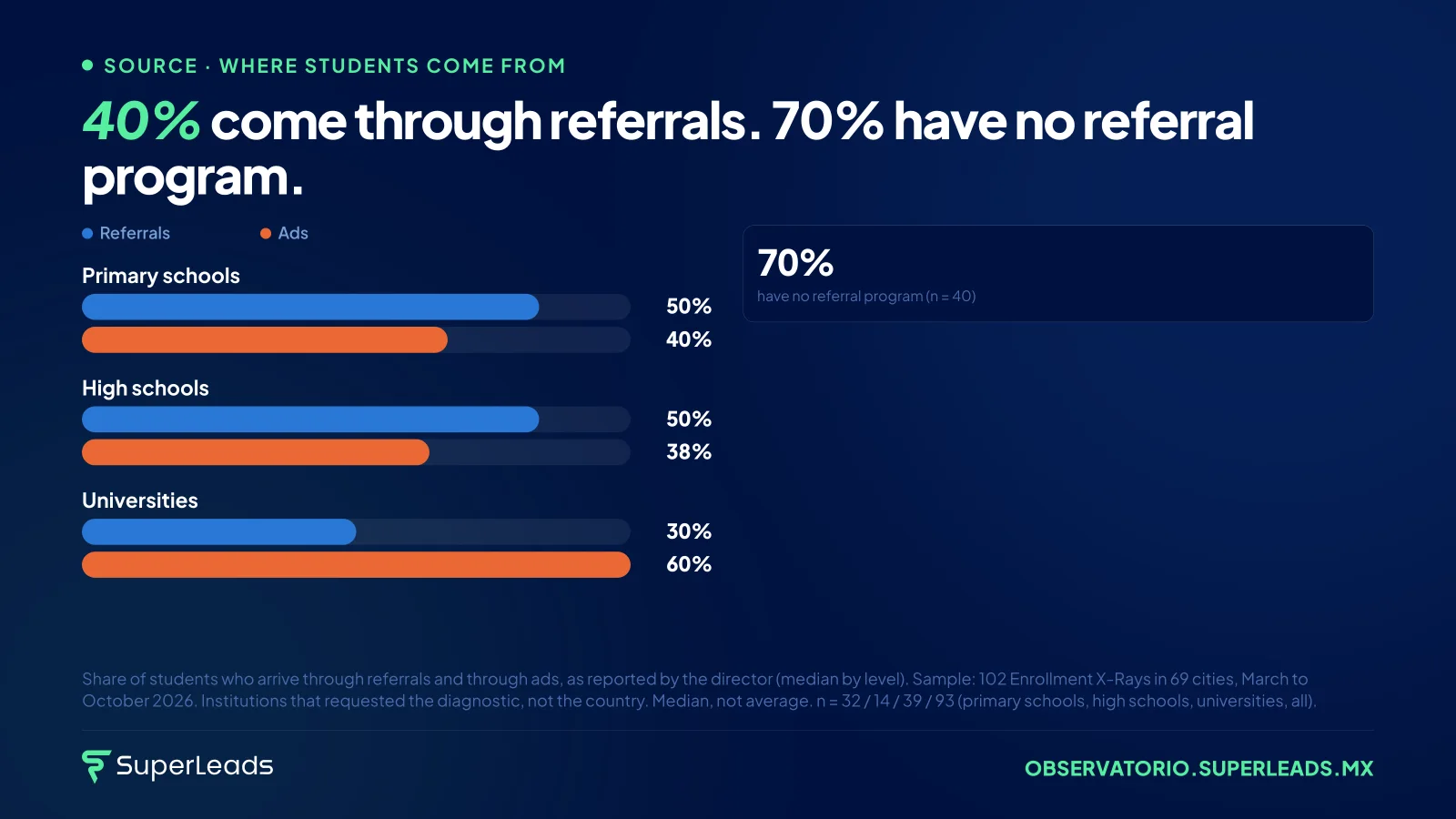
Referrals from other families bring in 40% of students; ads bring in 50%. And yet 70% of institutions have no referral program. The school’s cheapest, most trusted channel is the one nobody works.
Among revenue beyond tuition, the cafeteria (69%) and graduations (60%) are nearly universal; 57% charge for uniforms and books; 17% for transportation. What you already have is worth more than anything you still need to buy.
6. What the director believes
In the Enrollment X-Ray we also ask what the director believes. I put it that way, “believes,” because there are no measurements here: there are perceptions, and it pays not to confuse the two.
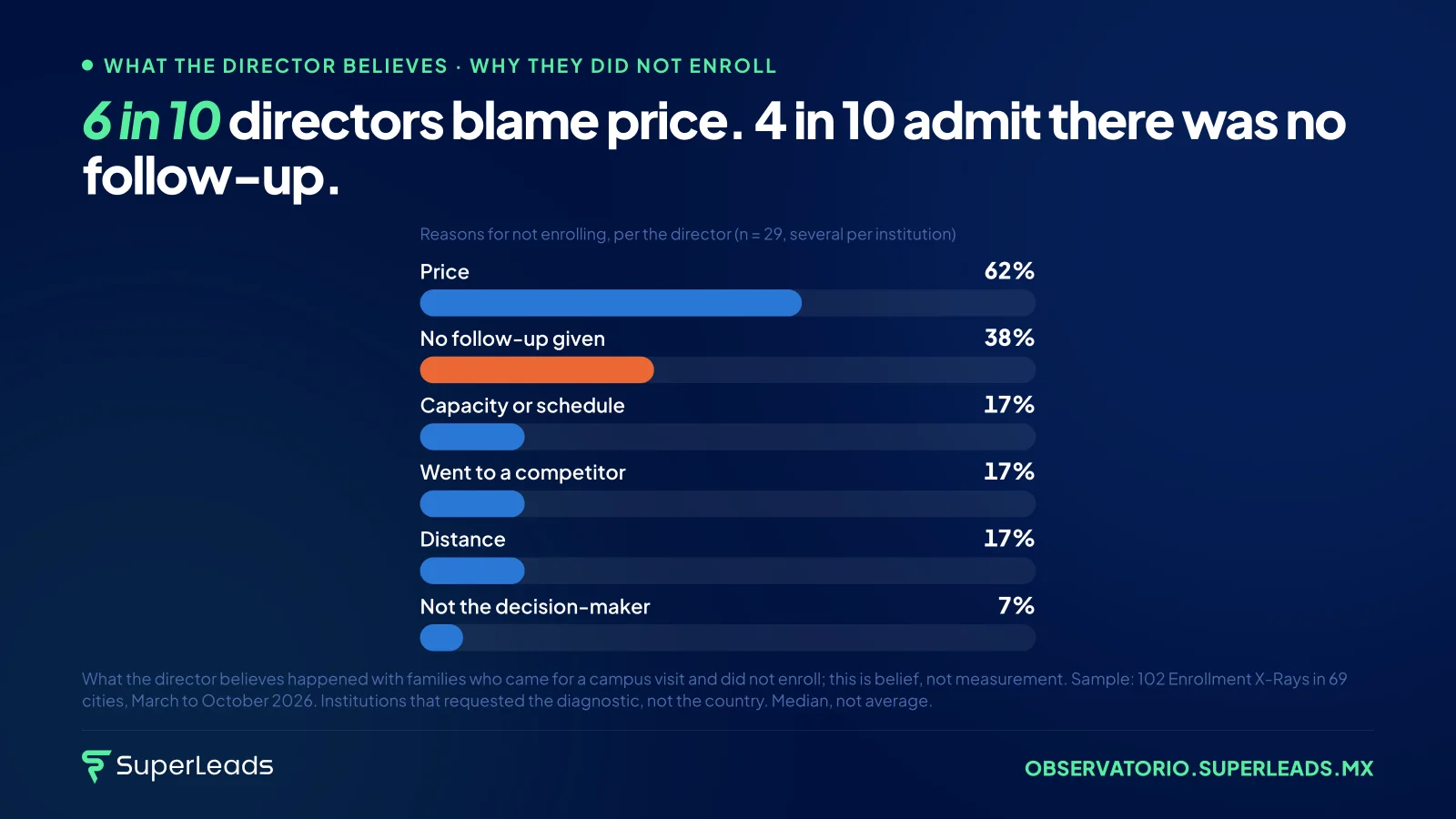
When we ask why the families who didn’t enroll didn’t enroll, the most cited reason is price (62%). Second comes lack of follow-up (38%). Then, at 17% each, capacity or schedule, competition, and distance. Look at the order: the first reason is in no one’s hands; the second is entirely within the school’s control.
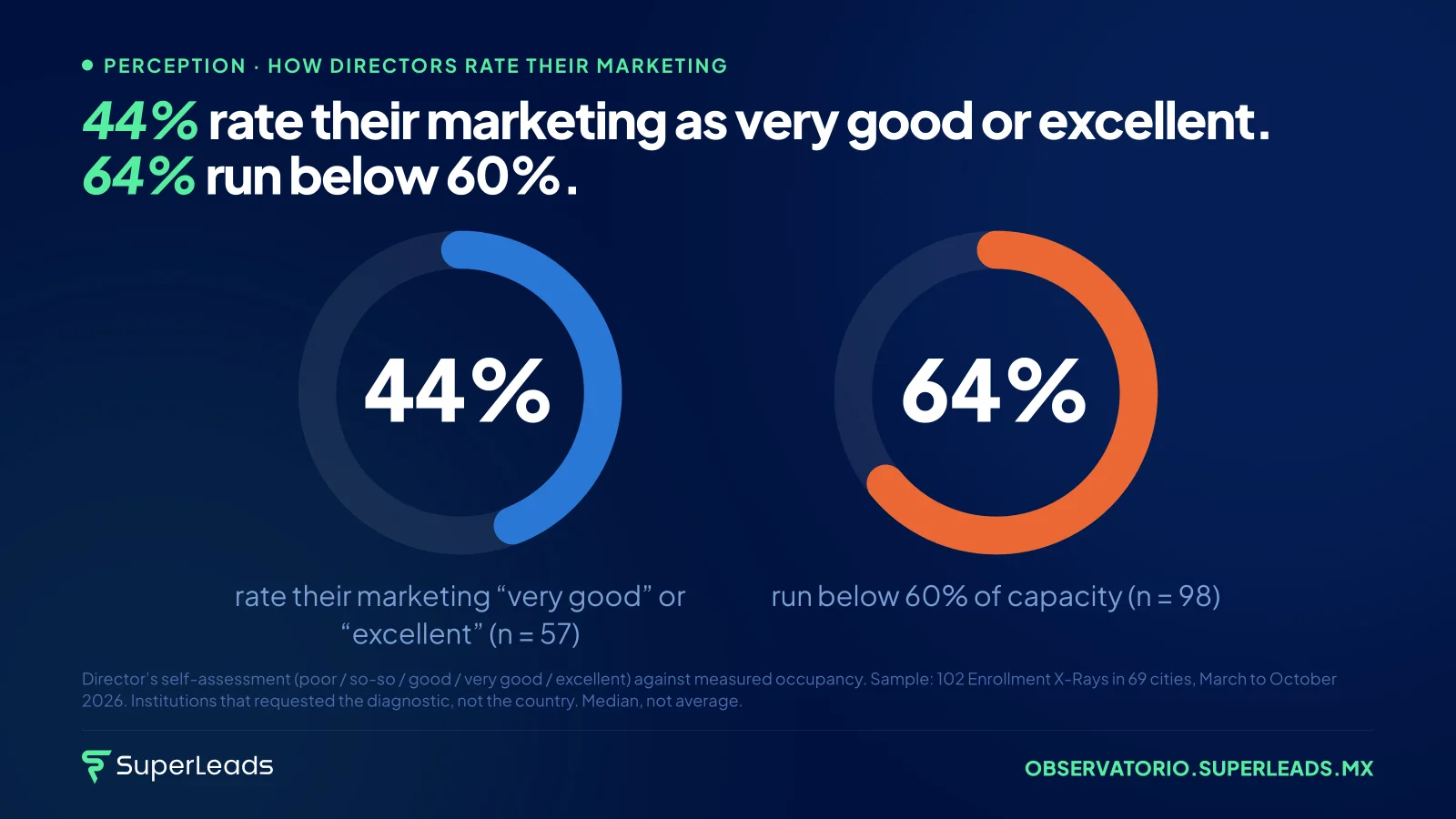
And when we ask how they rate their marketing, 44% call it very good or excellent. At the same time, 64% of institutions operate below 60% of their capacity. That gap between perception and reality is probably the most important chart in this entire edition. You can’t fix what you can’t see.
Findings from this edition
- The median private institution in Mexico operates at 46% of its capacity. There is demand available, there are seats available and there is infrastructure already paid for. What’s missing isn’t a market: it’s a process.
- Schools know how to close: 40% of the families who make it to the campus visit enroll. But only 2.4% of those who inquire end up enrolling. Enrollment is lost between the first message and the visit, not at the visit.
- A student costs $1,381MXN in advertising and is worth $144,000MXN. Advertising isn’t the problem. What it buys gets lost afterward, in the follow-up.
- One point of conversion is worth $109,500MXN a year to the median institution. It’s the cheapest growth there is: the families have already shown up.
- Seven in 10 institutions run admissions on WhatsApp and Excel, with one person and no compensation plan. The result is no accident: it’s the system they have.
- Directors blame price. The data blames silence. With median tuition of $3,300MXN and 13.4 million Mexican households able to pay it, price is rarely the reason.
What this is for
It’s for seeing where you stand. Take your occupancy, your conversion rate, your close rate at the visit, your cost per student and your lifetime value, and set them next to these medians. If you’re above them, you already have a system, and this edition confirms the size of what you’re capturing. If you’re below, you’re not alone: you’re with the majority, and the good news is that none of these figures depends on the market. All of them depend on process.
These numbers come from the Enrollment X-Rays we run at SuperLeads. It’s a working session with the owner or director in which we lay out their institution’s numbers exactly as they appear here, using their own data, and they walk away with a PDF of the key points. We’ll publish a new edition every six months, with the accumulated data, so the sector finally has a reference point other than hallway talk.
The next edition comes out in April 2027. If you want your institution in it, the Enrollment X-Ray is the way in: superleads.mx/rayos_x. And if you’d like to talk through these numbers with me, write to me directly: ricardo@superleads.mx.
Methodology note
Data as of October 29, 2026, at 18:08. We exported 110 Enrollment X-Rays; after removing tests, archived records and duplicates (one row per institution, the most recent), that leaves 102 institutions in 69 cities, completed between March 6 and October 28, 2026. Amounts are in Mexican pesos; institutions that report in dollars are excluded from the amounts. No figure based on fewer than five institutions is published. Medians, with quartiles and n per metric, are available on request: ricardo@superleads.mx.
SuperLeads Observatory · October 30, 2026